Front and Center Newsletter – Vol. 3, No. 12, December 2025
Meet the Marine. Be Inspired.
Opening June 8, 2026
Mission
Honor, preserve, and teach the legacy of Carolina Marines and Sailors.
Showcase the Marine example to inspire future generations.
Message from the President and CEO
Fellow Patriots,
As we enter this season of reflection and gratitude, I am profoundly thankful for the continued support of our donors, volunteers, Board of Directors, and partners across state and local government. Together, we are bringing the Carolina Museum of the Marine to life—an inspiring tribute to service, sacrifice, and the enduring legacy of Carolina Marines and Sailors.
This past month’s auto dealers’ event was another powerful demonstration of community partnership, and we extend our sincere thanks to the participating dealers who generously supported our mission. Their leadership, alongside yours, strengthens the foundation on which this museum is built.
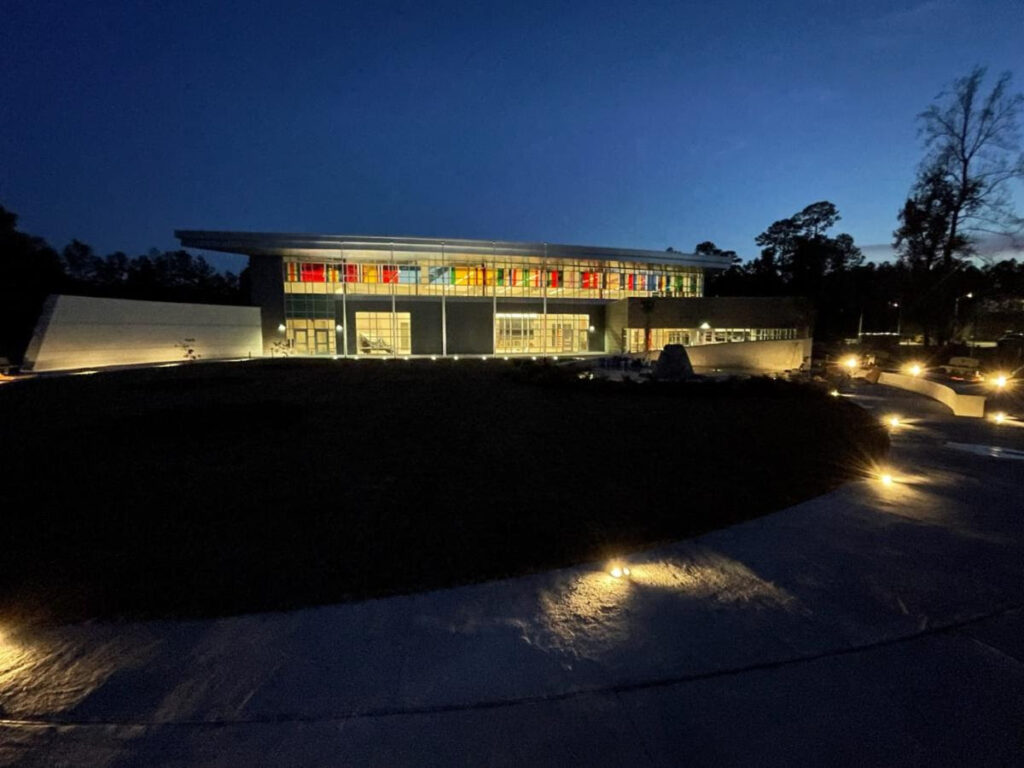
I am pleased to share that construction remains on track and will reach substantial completion at the end of this year. As we move into early 2026, exhibit installation will begin—an exciting phase that transforms steel, glass, and concrete into a vibrant storytelling environment. We also anticipate the arrival of two major artifacts, the Huey helicopter and the Landing Vehicle Tracked (LVT), in the coming weeks. These icons of Marine Corps history will play a central role in the visitor experience.
Our Plank Owner membership continues to grow, now with members in 28 states, the District of Columbia, and Puerto Rico. We are deeply grateful to each new supporter who has chosen to join this founding group and carry the mission forward.
In this issue, we are honored to highlight the extraordinary generosity of the Yanello family, whose commitment ensures that the Great Hall—one of the signature spaces of the museum—will stand as a tribute to courage, brotherhood, and faithful service. Their leadership exemplifies the spirit of giving that has made this entire project possible.
We also extend our appreciation to Samet Corporation, whose craftsmanship and steady partnership have guided the construction process with excellence. Their work ensures that when we open our doors in Spring 2026, we will welcome the public into a world-class facility worthy of the Marines and Sailors it honors.
As we look ahead, we will soon share details of our Founders Tribute Gala—an elegant celebration of the supporters who helped bring us to this moment—and of the Opening Day ceremonies that will unite military and civilian leaders, families, veterans, and the broader community in a powerful moment of dedication.
Finally, I want to draw your attention to Dr. James Danielson’s thoughtful essay in this issue. Last month, we reflected on North Carolina’s state motto, Esse Quam Videri—“To be, rather than to seem.” This month, Dr. Danielson turns to South Carolina’s two historic mottos, Dum Spiro Spero (“While I breathe, I hope”) and Animis Opibusque Parati (“Prepared in mind and resources”). Together, the mottos of our two states reflect the resilience, integrity, preparedness, and hope that define the Carolinas—and the very values upheld by the United States Marine Corps.
On behalf of our entire team, thank you for your unwavering support. Because of you, this museum is not only possible—it’s becoming remarkable. Best wishes to you and yours for a joyful holiday season.
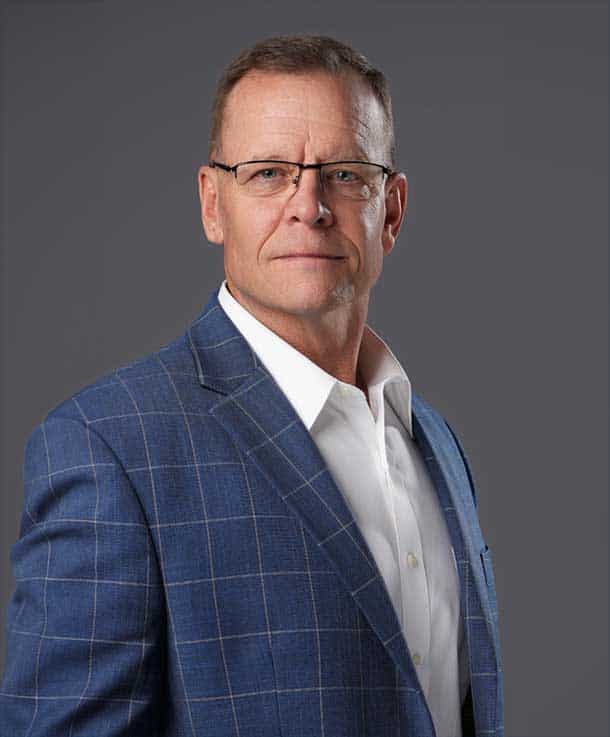
Warm regards,
Joe Schrader
Major General, USMC (Ret)
President and CEO
While Breathe, I Hope
Jim Danielson, PhD
Marine Veteran
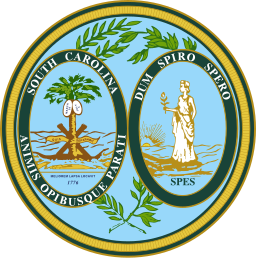
Government of the United States. Public domain, via Wikimedia Commons
Last month, we discussed the state motto of North Carolina and its implications for individuals and for society more broadly. This month, we follow the same process in examining the state motto of South Carolina. South Carolina actually has two mottos. The first is Animis Opibusque Parati, meaning “prepared in mind and resources.” The second motto is Dum Spiro Spero, meaning “while I breathe, I hope.” Both mottos are on the state seal, with the first one, “prepared in mind and resources,” bearing an image of a palmetto tree that recalls the victory in a battle against the British during our war for independence at what today is Fort Moultrie (mool-tree) on Sullivan’s Island that protected Charleston
In defense of Sullivan’s Island, defenders constructed a fort made of palmetto logs, referred to as the Palmetto Log Fort, that was able to withstand bombardment from British warships because the logs are relatively soft and spongy, and so they could absorb the force of cannonballs without shattering, giving to the South Carolinians the advantage of being able to return fire while under bombardment. In this way, the British attack was repelled and Sullivan’s Island, and thus the city of Charleston, were saved. This explains the motto “prepared in mind and resources.”
The motto Dum Spiro Spero, while I breathe, I hope, is a phrase of undetermined origin the earliest form of which, scholars believe, is found in the writings of the Greek poet Theocritus, who lived in the third century B.C. The phrase as it is found in Theocritus is worded this way: “While there is life, there is hope, and only the dead have none.” In a similar way, the Roman philosopher and statesman Marcus Tullius Cicero wrote to his friend, known generally as Atticus, saying in part: “As in the case of a sick man one says, ‘While there is life there is hope,…” The implication, of course, is that the kind of hope we experience in this life ceases when this life ceases, but conversely, while we live, there is hope for this life.

There is here an interesting parallel in American history that is found in a letter dated 6 September 1789 from Thomas Jefferson to James Madison. The two men had been in conversation concerning what Jefferson called “the elementary principles of society” such as the need for political power to be decentralized in order for people in their communities to govern themselves according to their local cultures and traditions. Yet there is one principle Jefferson thought important, but by that time had not been discussed in any serious way, and that because of Jefferson’s stated concern that the principle was not “very capable of proof.” The principle is presented by Jefferson saying: “I set out on this ground, which I suppose to be self-evident, ‘that the earth belongs in usufruct to the living’: that the dead have neither powers nor rights over it. The portion occupied by any individual ceases to be his when himself ceases to be,…” The concept of “usufruct” is of property which one has the right to use and to take profits from, but which belongs to someone else. In other words, the idea of property rights, Jefferson suggests, is not to insist that some piece of the earth actually belongs to someone in exclusion to all others, and forever, but rather to eliminate, as far as we can, confusion, here and now, concerning who has the right to the use and to the profit of an identifiable piece of land during his lifetime. No one can extend the rights of ownership over a piece of property into his death. Concerning my property and its value to me and to my family, while I breathe, I hope.
This example from Jefferson is used to put “flesh” on the South Carolina motto “While I breathe, I hope,” since it makes clear that the life we now live is the life of our immediate experience, and what we make of it, for good or ill, depends on what we do while we yet breathe. Of course, the making of a good life for a society requires among its various elements that we take heart and courage from those who went before us and who set for us examples of what it means to live with hope both for this life and for the one to come, which for many people, especially in our American tradition, was a source of hope here and now. Those who have gone before and have comported themselves in the finest traditions of their people, stand as emblems of the excellences a people see themselves as existing in history to embody. This is why it is important for a people to remember their history as accurately as they can, for this helps them understand who they are as a people. Importantly, and this is entailed in the motto of South Carolina, what one hopes while he yet breathes includes the effort both to be a person of the sort admired in his cultural tradition and to pass it on the to the next generation. And of course, we work to establish ourselves in life both for ourselves and also for our descendants who will be the hope of our people after we “cease to be.”

It is clear both from the state seals of North Carolina and South Carolina, but it seems to be especially true of South Carolina, that the seals, and the mottos that dignify them, are intended to capture the characters of the peoples of the Carolinas and their histories. It is an important observation for people in general, and certainly for the Marine Corps, that at all times, and especially in times when challenges appear to the valued ways of life of a people, that they find strength and encouragement in their history. This is why it is important that people preserve and remember their history as accurately as they can. We learn from our past, and from the past we may discover how to improve in the present. We return to this theme often because of its relevance to the mission of Carolina Museum of the Marine, and this is the wisdom contained in the first principle of Marine Corps leadership: “Know yourself, and seek self-improvement.” To know oneself, one must understand himself and his personal history accurately, and it is from this understanding that one may seek his own improvement. This is true of individuals, and it is true of peoples. To learn and to grow are vital elements in developing as a person and in living a satisfying and happy life, and it is vital also to the growth and development of a society. Here again we may invoke a truth we have returned to often from Albert Jay Nock: if we wish to contribute to the improvement of our society, the best thing we can do is to “present it with one improved unit,” which is, of course, ourselves. This we do for self and country, understanding the challenges involved, and this embraces the wisdom in the motto of South Carolina: “While I breathe, I hope.”
Returning Good Citizens
Answering the Call – Again and Again
Beginning in January, our ‘Returning Good Citizens’ feature will spotlight additional generous supporters who have made naming gifts to the Museum. Each story reflects the values of service, leadership, and legacy that define Carolina Marines and Sailors. We are deeply grateful to every donor who has chosen to Carry the Legacy Forward.
Ralph and Teresa Yanello
Honoring Service. Elevating Community.
Corporal E-4 Ralph Yanello served our Nation as a United States Marine from 1959 to 1963. Today, more than six decades later, he and his wife, Teresa, continue to serve—this time through leadership, philanthropy, and a commitment to community well-being that exemplifies the very best of “Returning Good Citizens.”
After completing his military service, Ralph built a successful career as an attorney and entrepreneur, pioneering legal services that made access to justice affordable and attainable. Together, he and Teresa have spent their lives investing in initiatives that reflect their shared values of health, service, and opportunity. Their longtime dedication to fitness and whole-person wellness inspired significant philanthropic support of integrative medicine and veteran health innovations in their home community.
Ralph and Teresa’s belief in lifting others up has now extended to the Carolina Museum of the Marine. In honor of Ralph’s beloved younger brother, Col Gerald Yanello, USMC (1975-2005), they have pledged $500,000 to name The Great Hall—a sacred space where the stories, sacrifices, and legacies of Carolina Marines will be brought to life for generations to come.
“My brother and I choose to support this museum because of our love for the Marine Corps and for America, the greatest country on the planet.” Ralph Yanello
Their gift, given in quiet strength and deep humility, reflects more than generosity. It honors the unbreakable bond of brothers—in life, in arms, and in service to something greater than oneself. Semper Fidelis to the Yanellos—true examples of enduring service, unwavering purpose, and the spirit of “Returning Good Citizens.
Please check out the naming and sponsorship opportunities at the link below.
Auto Dealers Event Update
Sanders Ford and Stevenson-Hendrick Toyota Jacksonville each made a generous donation to Carolina Museum of the Marine for every vehicle they sold in November. Their longstanding support of our mission to honor service, inspire leadership, and educate future generations mirrors the values of our Marines and Sailors. With every car sold, they helped bring our museum one step closer to opening its doors Jume 8, 2026—right here in Jacksonville, NC.
Plank Owner Campaign Extended!
Become a Founding Plank Owner Member of the Carolina Museum of the Marine and be among the first to stand with those who’ve served. Enjoy exclusive recognition, special benefits, and lasting impact—honoring our Carolina Marines and Sailors and inspiring generations to come.
VISIT OUR ONLINE GIFT SHOP!

https://www.istockphoto.com/portfolio/SARINYAPINNGAM?mediatype=photography
Please join us in supporting the mission of
Carolina Museum of the Marine.
When you give to our annual campaign, you help to ensure that operations continue during construction and when the doors open!
Stand with us
as we stand up the Museum!
Copyright, December 2025. Carolina Museum of the Marine
2025-2026 Board of Directors
Executive Committee
LtGen Mark Faulkner, USMC (Ret) – Chair
Col Bob Love, USMC (Ret) – Vice Chair
CAPT Pat Alford, USN (Ret) – Treasurer
Mr. Mark Cramer, JD – Secretary
In Memoriam: General Al Gray, USMC (Ret)
MajGen Jim Kessler, USMC (Ret)
Col Grant Sparks, USMC (Ret)
MajGen Joe Shrader, USMC (Ret), President and CEO, Ex Officio Board Member
Members
Col Joe Atkins, USAF (Ret)
Mr. Mike Bogdahn, US Marine Corps Veteran
Mr. Keith Byrd, US Marine Corps Veteran
MGySgt Osceola “Oats” Elliss, USMC (Ret)
Col Bruce Gombar, USMC (Ret)
LtGen Robert “Fuzzy” Hedelund, USMC (Ret)
LtCol Lynn “Kim” Kimball, USMC (Ret)
CWO4 Richard McIntosh, USMC (Ret)
LtGen Gary S. McKissock, USMC (Ret)
Ms. Sandra Perez
The Honorable Robert Sander, Former General Counsel of the Navy
Mr. Billy Sewell
Col John B. Sollis, USMC (Ret)
Staff
MajGen Joe Shrader, USMC (Ret), President and Chief Executive Officer
Ashley Danielson, VP of Development
SgtMaj Steven Lunsford, USMC (Ret), VP of Operations
CWO3 Charles McCawley, Finance and HR Manager
CWO5 Lisa Potts, USMC (Ret). Curator
Sarah Williams, Docent and Volunteer Manager
Alex Price, Curatorial Assistant