Front and Center Newsletter – Vol. 3, No. 01, January 2026
Meet the Marine. Be Inspired.
Opening Spring of 2026
Lejeune Memorial Gardens, Jacksonville, NC

Mission
Honor, preserve, and teach the legacy of Carolina Marines and Sailors.
Showcase the Marine example to inspire future generations.
Message from the President and CEO
Fellow Patriots,
As the Museum enters one of the most exciting phases of its journey—exhibit fabrication and installation—the stories of Carolina Marines and Sailors are taking physical shape inside the Museum. Each artifact placed and each exhibit assembled brings us closer to opening day.
While the Museum is a place of history and remembrance, it is also a place of learning. General Al Gray often reminded us that leadership and citizenship depend not simply on what we are told, but on how we think—how we analyze information, weigh evidence, and exercise sound judgment. That belief shaped his decision to establish the Al Gray Marine Leadership Forum, grounded in the principle of teaching how to think, not what to think.
In this issue, Dr. Jim Danielson explores the importance of critical thinking, drawing on Marine Corps leadership principles and the enduring values General Gray championed throughout his life. His essay challenges all of us—young and old—to think carefully, act ethically, and engage honestly with the world around us.
You will also read the story of Marine veteran and entrepreneur Keith Byrd, whose success in business and philanthropy reflects those same habits of thoughtful leadership. Keith often credits the Marine Corps with teaching him how to think under pressure and lead with integrity—lessons that have shaped his life well beyond his time in uniform.
As we approach opening day, our focus remains on completing the Museum and preparing it to welcome visitors from across the Carolinas and beyond. At the same time, we remain mindful that the ideas represented here—service, leadership, critical thinking, and citizenship—are just as important as the walls and exhibits that house them.
Thank you for your continued support as we take these final steps toward opening the Carolina Museum of the Marine this spring.
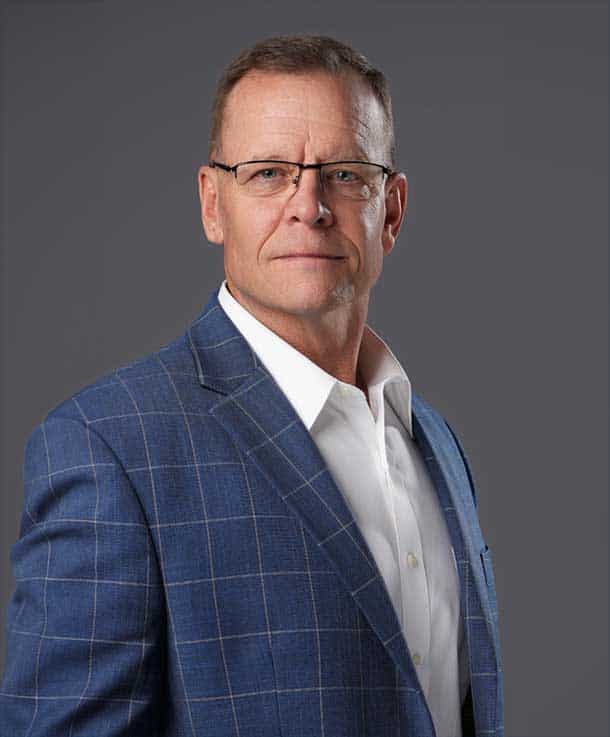
Semper Fidelis,
Joe Schrader
Major General, USMC (Ret)
President and CEO
The Importance of Critical Thinking
Jim Danielson, PhD
Marine Veteran
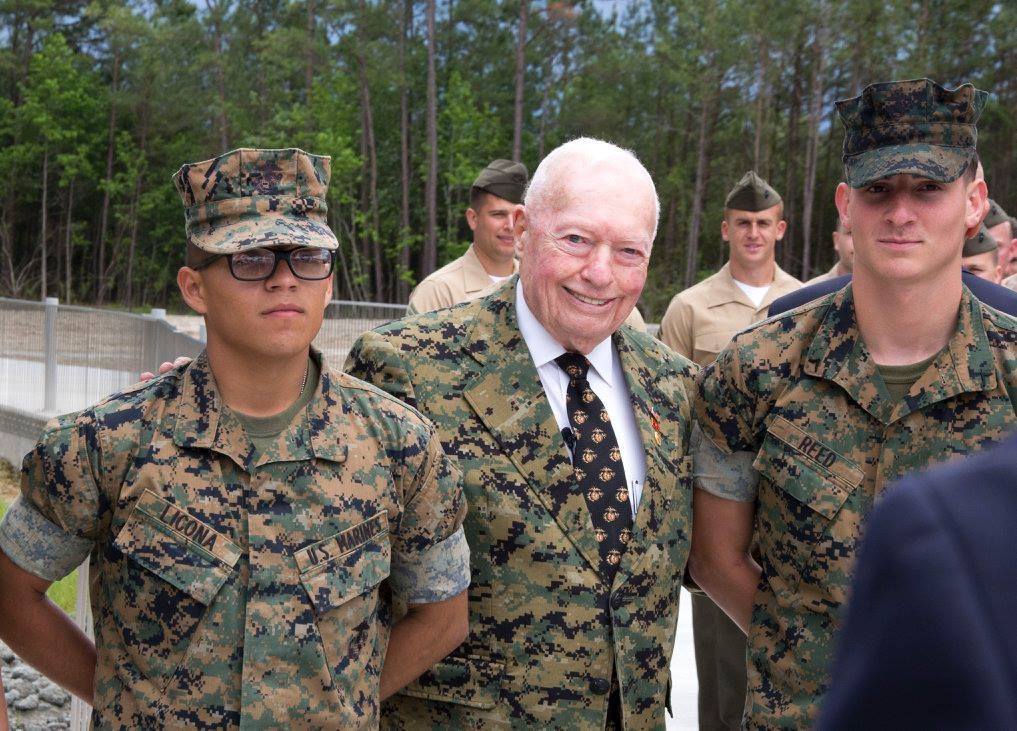
Government of the United States. Public domain, via Wikimedia Commons
On January 6, 1816, Thomas Jefferson, having retired from public life, wrote to a friend named Charles Yancey saying in part: “If a nation expects to be ignorant & free, in a state of civilization, it expects what never was & never will be. The functionaries of every government have propensities to command at will the liberty & property of their constituents. There is no safe deposit for these but with the people themselves; nor can they be safe with them without information. Where the press is free and every man able to read, all is safe.” Large ideas that are communicated concisely and in narrow scope are always subject to question and even hesitation, but Jefferson’s point here is clear. In order for people to take sound decisions concerning themselves and their families, they must accurately be informed. This requires that people are able to read skillfully, but also, and importantly, that people who engage in conversation with others, and especially in public discourse, speak and write honestly.
This process of speaking and writing honestly requires that people develop and practice the ability to think carefully and critically. In a written communication some years ago, General Gray described critical thinking this way. “There are many definitions of this complex topic. For me it is the study and analysis of problems, issues and facts to develop and form a sound judgment. It involves evaluation of the facts or evidence bearing on the problem or issue. It is self-directed, self-disciplined, self-monitored, and self-corrected thinking,… Our intent, in part, is to draw upon Carolina Marine experiences in terms of the development of our Warfighting Philosophy and our Leadership Thoughts.”
As General Gray presents the practice of critical thinking it begins with “study and analysis,” and this at levels suited to the matter under consideration, and this practice of study and analysis is the process Thomas Jefferson alludes to when he identifies the importance of adequate information to taking sound decisions. It is important to consider that in order to think and to speak critically with consistency, the skill involves not just intellectual discipline but also inwardly possessed moral order since it is from this that one maintains the determination always to communicate honestly with others. Among the nearly limitless examples we could use to illustrate this truth is one we have used before, though for a different purpose, namely the oaths taken by Marines and Sailors when they enter into military service.

Upon entering the Marine Corps or the Navy, a prospective officer takes the following oath. “I (name), having been appointed a (rank) in the United States (Marine Corps or Navy), do solemnly swear (or affirm) that I will support and defend the Constitution of the United States against all enemies, foreign and domestic; that I will bear true faith and allegiance to the same; that I take this obligation freely, without any mental reservation or purpose of evasion; and that I will well and faithfully discharge the office upon which I am about to enter. So help me God.” Enlisted Marines and sailors take the following oath. “I (name), do solemnly swear (or affirm) that I will support and defend the Constitution of the United States against all enemies, foreign and domestic; that I will bear true faith and allegiance to the same; and that I will obey the orders of the President of the United States and the orders of the officers appointed over me, according to regulations and the Uniform Code of Military Justice. So help me God.”
What stands out first in both of these oaths is the pledge to “support and defend the Constitution of the United States against all enemies, foreign and domestic;…” Of course, enemies of the Constitution are in fact enemies of the way of life defended by our Constitution that establishes a governing order of restraint and limited power that provides for a free people to govern themselves according to their own customs and traditions. This is natural to us as human beings as well as Americans because the things people have always been willing to risk themselves to defend are God, family, country, and their valued and shared ways of life. This makes clear sense of the next part of the oath to “bear true faith and allegiance to the same.” To support and defend that Constitution is a call to certain kinds of action, and to bear true faith and allegiance identifies the inner moral disposition one must possess or otherwise develop, since it is from this true faith and allegiance that a Marine or a Sailor is motivated to support and defend.
In order for Marines and Sailors to fulfill this part of their oaths they do well to develop such traits of a Marine leader as a sense of justice by which one may understand the behaviors that express allegiance to the Constitution of the United States and the way of life it exists to defend. Judgment is needed in order consistently to act justly, and this is made more certain by the personal quality of dependability. The possession of integrity is the possession of a sense of honor by which it would be unthinkable to act in ways that are faithless or cowardly, and so we can understand why a leader must possess courage and loyalty. And certainly, to take an oath freely, without any purpose of evasion, is simply to be who one appears to be, and this is a quality of someone able to bear true faith and allegiance to a cause bearing high purpose. Doing all of this well is fundamentally the fruit of the ability consistently to think critically.
People who have been alive for a while, as many of the patriots associated with Carolina Museum of the Marine have been, understand from experience that a bracing characteristic of life lived within the discipline of a well-wrought tradition is personal growth that is at once intellectual, moral, and spiritual. We have also experience of people who are perfectly fine and well-meaning but who, over the course of their lives, have grown as human beings very little, if at all. This is a concern we have written about here quite a bit because growth as a human being is an integral part of a full and happy life, and because the more well-developed people in a society, the better that society will be. Addressing this issue was an important concern for General Gray, and it was central to his decision to join with us at Carolina Museum of the Marine.
With this issue of “Front and Center,” we embark upon a new year. Among the signs of a year’s end and the start of a new one about which people might be ambivalent are year-end round-ups and predictions for the coming year. We won’t do either of these, but this is the year that Carolina Museum of the Marine opens to the public, and we should not fail to take note of this important and rapidly approaching event. So then: the Museum opens this year, and from the moment it commences operations people may enjoy the multi-faceted celebration of the achievements and contributions to our country of the Marines and Sailors of the Carolinas, and the lessons for citizenship and for life that we find among them.
Returning Good Citizens
Answering the Call – Again and Again
Beginning in January, our ‘Returning Good Citizens’ feature will spotlight additional generous supporters who have made naming gifts to the Museum. Each story reflects the values of service, leadership, and legacy that define Carolina Marines and Sailors. We are deeply grateful to every donor who has chosen to Carry the Legacy Forward.
Keith and Ginger Byrd
Marine Values, Critical Thinking,
Leadership that Endures
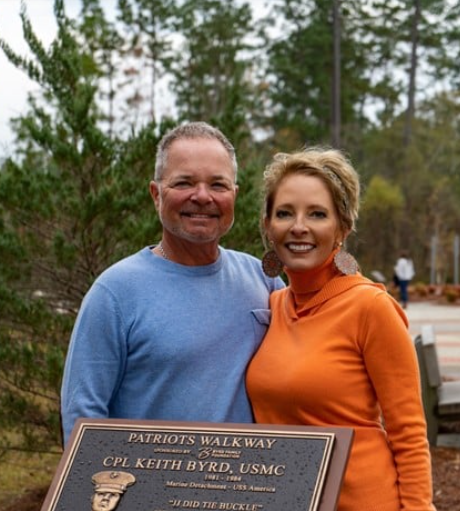
For many Marines, the most enduring lessons of service are not only about discipline or resilience, but about how to think — how to assess a situation, make sound decisions under pressure, and lead with integrity. For Keith Byrd, those lessons became the foundation for a life of entrepreneurial success and purposeful philanthropy.
A Marine Corps veteran, Keith often credits the Corps with instilling the critical thinking skills that shaped his approach to leadership and business — the ability to analyze challenges carefully, weigh options thoughtfully, and act decisively while remaining grounded in core values. Those habits of mind did not fade when he hung up the uniform; they carried forward into every chapter that followed.
After his Marine service, Keith co-founded Transportation Impact, a logistics and freight-management company that began modestly and grew into a nationally recognized enterprise. Today known as TransImpact, the company achieved tens of millions in annual revenue before Keith sold the business. He continues to serve on the Board, offering strategic guidance rooted in the same disciplined judgment and foresight he learned as a Marine.
Keith’s journey is chronicled in his book, Broom Closet to Park Avenue: A Legacy of Vision, Determination, and Entrepreneurial Success, which reflects not only a remarkable business story, but a mindset shaped by vision, determination, and careful judgment — hallmarks of Marine leadership.
Together with his wife, Ginger, Keith has carried those values into philanthropy. Through the Byrd Family Foundation, the Byrds made significant six-figure gifts to the Carolina Museum of the Marine, naming both Patriots Walkway and the Museum’s Eternal Flame Courtyard. These spaces serve as places of reflection and remembrance, honoring the service and sacrifice of Marines and Sailors past and present.
Beyond these visible tributes, Keith and Ginger’s support came at a defining moment in the Museum’s journey. As the organization bridged the critical transition between the completion of Phase I and the State of North Carolina’s award for Phase II, the Byrds stepped forward with extraordinary confidence in the mission. Their leadership-level generosity helped sustain momentum, stability, and forward progress at a time when it mattered most — reflecting the same Marine values of judgment, decisiveness, and unselfishness honored today along Patriots Walkway.
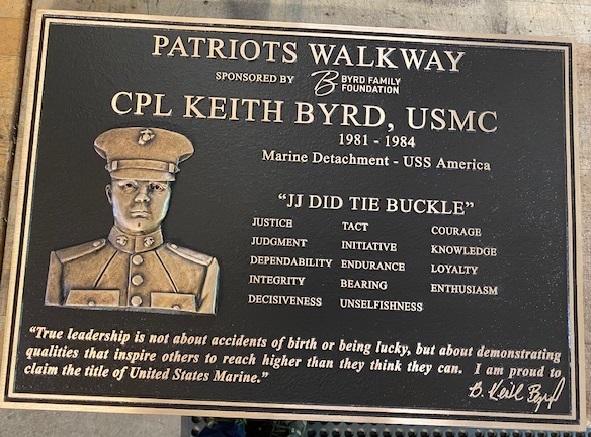
_____That connection is made explicit on the Patriots Walkway plaque dedicated to Corporal Keith Byrd, USMC, which bears the Marine Corps leadership maxim “JJ DID TIE BUCKLE.” The qualities it names — justice, judgment, integrity, decisiveness, initiative, courage, and unselfishness — are not abstract ideals. They are the very principles that guided Keith and Ginger’s actions when the Museum needed leadership most.
Their generosity is also deeply personal. Across the Museum grounds, the Byrds have donated several named benches in honor of Marines whose service held special meaning to them — including Keith’s own father. Each bench stands as a quiet testament to family, service, and the enduring influence of Marine values across generations.
Keith Byrd’s story reminds us that the Marine Corps does more than prepare individuals for combat — it prepares them for life, and for moments when leadership, judgment, and generosity are required beyond the battlefield — precisely the qualities the Al Gray Marine Leadership Forum seeks to cultivate in civilians.
Plank Owner Registration
Become a Founding Plank Owner Member of the Carolina Museum of the Marine and be among the first to stand with those who’ve served. Enjoy exclusive recognition, special benefits, and lasting impact—honoring our Carolina Marines and Sailors and inspiring generations to come.
VISIT OUR ONLINE GIFT SHOP!

https://www.istockphoto.com/portfolio/SARINYAPINNGAM?mediatype=photography
Please join us in supporting the mission of
Carolina Museum of the Marine.
When you give to our annual campaign, you help to ensure that operations continue during construction and when the doors open!
Stand with us
as we stand up the Museum!
Copyright, January 2026. Carolina Museum of the Marine
2025-2026 Board of Directors
Executive Committee
LtGen Mark Faulkner, USMC (Ret) – Chair
Col Bob Love, USMC (Ret) – Vice Chair
CAPT Pat Alford, USN (Ret) – Treasurer
Mr. Mark Cramer, JD – Secretary
In Memoriam: General Al Gray, USMC (Ret)
MajGen Jim Kessler, USMC (Ret)
Col Grant Sparks, USMC (Ret)
MajGen Joe Shrader, USMC (Ret), President and CEO, Ex Officio Board Member
Members
Col Joe Atkins, USAF (Ret)
Mr. Mike Bogdahn, US Marine Corps Veteran
Mr. Keith Byrd, US Marine Corps Veteran
MGySgt Osceola “Oats” Elliss, USMC (Ret)
Col Bruce Gombar, USMC (Ret)
LtGen Robert “Fuzzy” Hedelund, USMC (Ret)
LtCol Lynn “Kim” Kimball, USMC (Ret)
CWO4 Richard McIntosh, USMC (Ret)
LtGen Gary S. McKissock, USMC (Ret)
Ms. Sandra Perez
The Honorable Robert Sander, Former General Counsel of the Navy
Mr. Billy Sewell
Col John B. Sollis, USMC (Ret)
Staff
MajGen Joe Shrader, USMC (Ret), President and Chief Executive Officer
Ashley Danielson, VP of Development
SgtMaj Steven Lunsford, USMC (Ret), VP of Operations
CWO5 Lisa Potts, USMC (Ret). Curator
CWO3 Charles McCawley, Finance and HR Manager
Sarah Williams, Docent and Volunteer Manager
Alexandra Price, Curatorial Assistant