
Front and Center Newsletter – Vol. 3, No. 03, March 2026
Meet the Marine. Be Inspired.
Opening to the Public
June 8, 2026
Lejeune Memorial Gardens, Jacksonville, NC

Mission
Honor, preserve, and teach the legacy of Carolina Marines and Sailors.
Showcase the Marine example to inspire future generations.
Message from the President and CEO
Dear Friends of the Museum,
This month’s essay, Education for a Good Society, reminds us that the strength of any institution — whether a school, a family, or a military force — depends upon the character and formation of the individual. As the 1991 Concepts and Issues publication noted, “The Marine Corps’ most potent answer to an unpredictable and turbulent future is the individual Marine.” The quality of the Corps begins with the quality of its people.
That truth is embodied in the lives of Dr. Brenda Johnson and GySgt Thomas Moore. One dedicated his life to defending our nation; the other devoted hers to shaping the minds and character of young people. Together, they reflect the powerful partnership between disciplined service and thoughtful education — the very foundation of the Al Gray Marine Leadership Forum and of our broader mission at the Carolina Museum of the Marine.
As we move steadily toward opening day, we continue to build the team and partnerships that will bring this vision to life.
We are pleased to welcome Ashlee Escareno as our Events and Facilities Manager. Ashlee will serve as the point of contact for individuals and organizations interested in reserving the Museum for retirements, promotions, reenlistments, Marine Corps balls, weddings, corporate gatherings, and other special events. The Museum is designed to be a place where the traditions of the Corps are celebrated and where our community gathers, and Ashlee’s leadership will ensure those events are executed with excellence.
We are also excited to be working with Hadley Exhibits, Inc. for the fabrication and installation of our exhibits and galleries. Their expertise will help transform our galleries into immersive spaces that tell the story of Carolina Marines and Sailors with authenticity, honor, and impact.
Every week brings visible progress. Every week draws us closer.
On June 8 at 10:00 a.m., the Carolina Museum of the Marine will open its doors to the public. It will be a day of pride, remembrance, and anticipation — not just of what we have built, but of what this Museum will mean for generations to come.
We look forward to welcoming you.
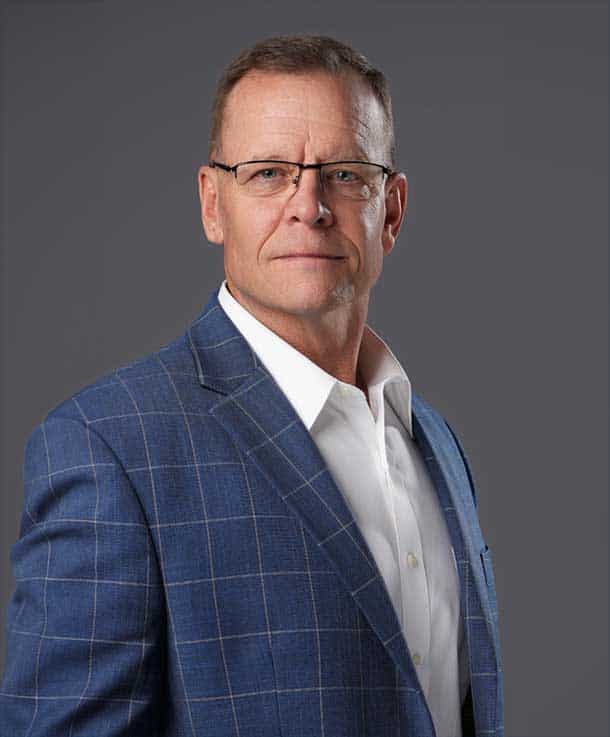
Semper Fidelis,
Joe Schrader
Major General, USMC (Ret)
President and CEO
Education for a Good Society
Jim Danielson, PhD
Marine Veteran
A 1991 issue of United States Marine Corps: Concepts and Issues, published when General Gray was commandant, begins with this statement of purpose: “Concepts and Issues provides a brief description of how the Marine Corps is organized, what particular contributions the Marines make to our national defense, and those steps taken by the senior leadership of the Department of the Navy to ensure that our naval expeditionary forces continue to be prepared to meet the challenges of the 21st century.” The document is brief, as the opening statement tells us, but it is nevertheless a wealth of information with no small amount of detail. On page 2-19 of the document, we read the following: “The Marine Corps’ most potent answer to an unpredictable and turbulent future is the individual Marine. Our top most priority has therefore been to recruit and retain the very best active and reserve force that American society has to offer.” This is a very clear statement of the potent truth that the quality of individual Americans is important for the quality of the Marine Corps, and in fact, for families, schools, communities, and every other aspect of a healthy society.
In Republic, and elsewhere, Plato asserts that no society can be just whose citizens are inwardly unjust. By this Plato meant that a society in which people are able to flourish as human beings is one in which the members of the society have well-ordered souls. This might appear to be saying that a society in which human beings may flourish as human beings is one in which human beings do flourish as human beings. The fact that this is true attests to the importance among a people of a living cultural tradition in which the benefits of the tradition are passed from one generation to the next through family, religion, and education. Importantly, education is not the work of schools alone, but of schools working in tandem with families. Ideally, the formation of well-ordered souls is understood in a society to be the primary work of the family, and this is why education of the young among ancient Athenians was training in the habits of goodness, or virtue. The idea was that when we train children to behave virtuously and to think skillfully, then when they reach the age of reason and can truly think things through on their own, they will understand why they were educated as they were, they will not have bad habits to overcome, and importantly, they will already be on the path of guiding their lives according to truth and principle.
This understanding of education did not die with the Athenians. In the early Middle Ages we see the beginnings of a similar kind of education in the writings of a Roman senator and philosopher known generally as Boethius. In time, the methods of education that developed were known as the trivium and the quadrivium. The trivium is comprised of grammar, logic, and rhetoric. These disciplines trained young minds to think carefully and skillfully and to speak with clarity and confidence. The study of grammar teaches students to understand the structure of their language and to appreciate writing that is well-crafted. Logic brings discipline to the mind and empowers the student to identify faulty arguments when he hears them. Rhetoric was the art of speaking skillfully and persuasively. Aristotle wrote an influential treatise on rhetoric in which he divides a presentation to an audience into three parts: ethos, logos, and pathos. Ethos is the part of a discussion in which the speaker seeks to convince the hearers that he is qualified to speak on the topic. Logos is the actual argument or explanation, and pathos is the attempt by the speaker to help the hearers identify affectively (similar to “emotionally,” but not quite) with the argument.[i] In all of this, the underlying understanding is that when one undertakes to speak to others, he has the obligation to speak honestly. One might be mistaken, but a mistake is not a lie, and mistakes can be identified and corrected in honest conversation.
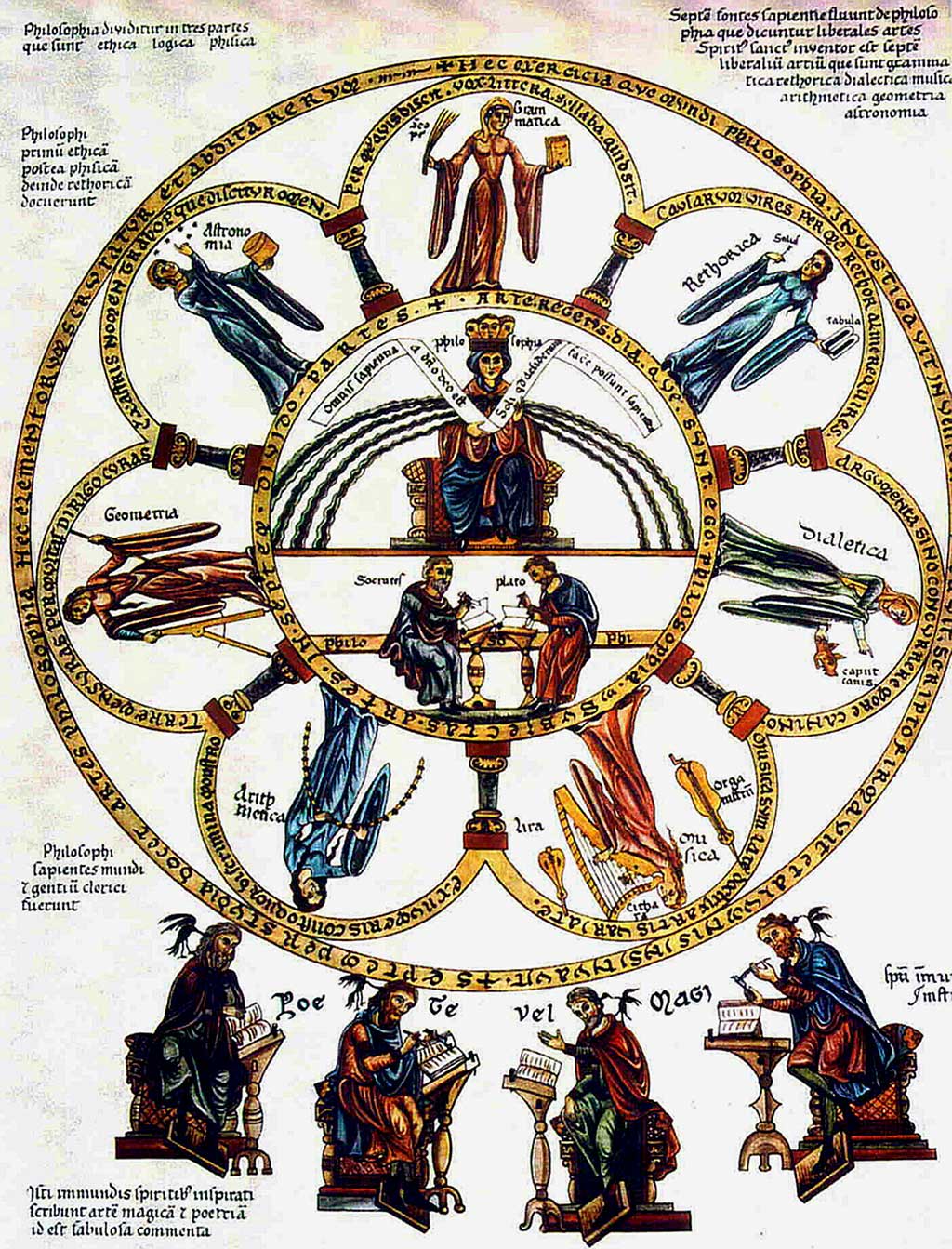
The quadrivium is comprised of arithmetic, geometry, music, and astronomy. The study of arithmetic and geometry were intended primarily to train the mind to think abstractly, since this skill is needed in order to think and to analyze things deeply.[ii] The study of music is the study of the relationships of measure, form, and order to beauty. This is important as part of the pursuit of what was taken to be what the mind most needs to know: the good, the true, and the beautiful. The study of astronomy seeks to help the student understand the order of the heavens as a depiction of the realm in which he lives. As above, so below.
_____The idea both among the Athenians and the Europeans of the Middle Ages was that when we train people from childhood in the habits of goodness, and this includes training their minds to think with discipline and skill, we ensure at the same time that our societies will be much better for it. This takes us back to the quote above from Concepts and Issues that the topmost priority of the Marine Corps is to recruit and retain the best people American society has to offer. The idea of education and society discussed here is able to raise and prepare people the Marine Corps can train to be warriors for the defense of our country that no enemy will want to encounter. Such people would arrive at basic training already practicing the first principle of Marine Corps leadership to know yourself and to seek self-improvement. Such people also would be ready to fulfill General Gray’s admonition that we have to “out-think the other guy”.
_____The Al Gray Marine Leadership Forum at Carolina Museum of the Marine seeks to use the lessons and examples of the Marine Corps to help Americans at large grow as human beings. This will improve their lives and families, and our society. It will also ensure that those Americans who are the best that American society has to offer will be very good indeed.
[i] We sometimes hear in a discussion something like this. A person makes an argument about the form of government found in the Constitution of the United States and the other person says: “You can’t say that because you didn’t go to law school.” The person making this reply has made the mistake of confusing the ethos part of a presentation with the logos part.
[ii] Plato insisted that no one who hasn’t mastered geometry should be allowed to study philosophy before the age of fifty, because it takes a life that long to learn to think abstractly without the study of geometry.
Returning Good Citizens
Answering the Call – Again and Again
Beginning in January 2026, our ‘Returning Good Citizens’ feature spotlights generous supporters who have made naming gifts to the Museum. Each story reflects the values of service, leadership, and legacy that define Carolina Marines and Sailors. We are deeply grateful to every donor who has chosen to Carry the Legacy Forward.
A Love Story of Service:
Dr. Brenda Johnson and GySgt Thomas Moore
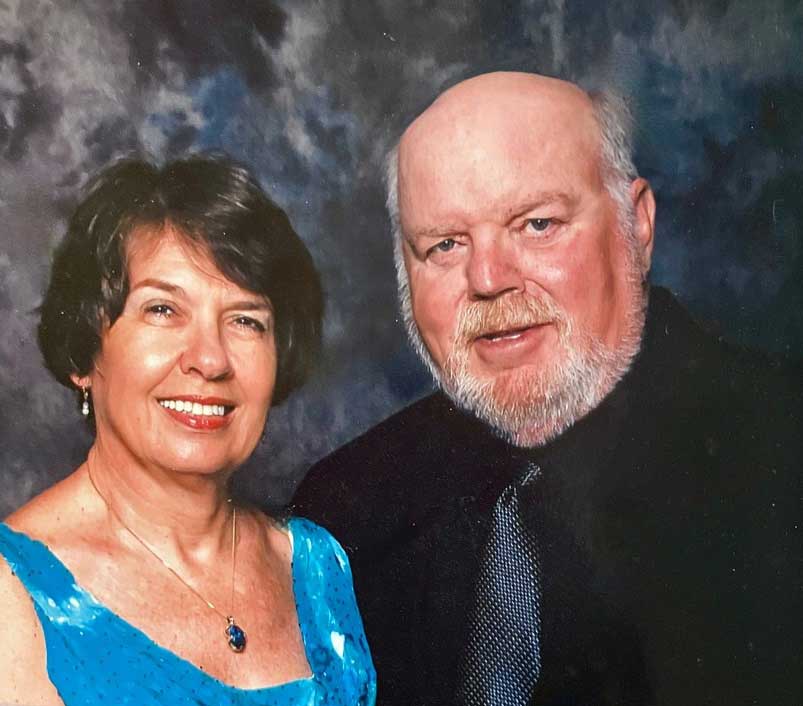
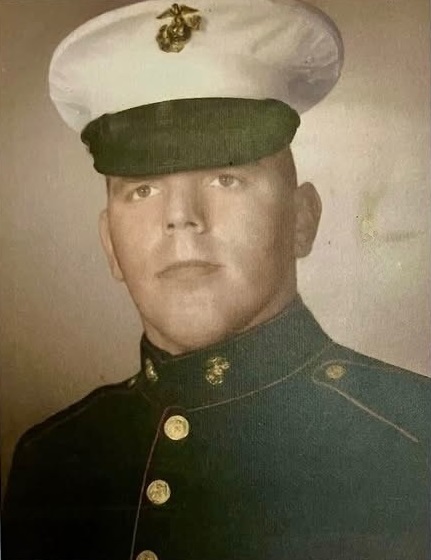
Tom Moore, Class of 1958, and Brenda Johnson, Class of 1959, were high school sweethearts in Winston-Salem — captain of the football team and chief cheerleader, Most Valuable Player and Forsyth County spelling champion. His path led to the United States Marine Corps; hers to a lifetime devoted to education.
As detailed in the biography she shared, their early years took them in different directions. Tom served two tours in Vietnam, worked with the Armed Forces Police in San Francisco during the “Summer of Love,” and became a top recruiter in the St. Louis region. Brenda advanced innovative programs at the North Carolina School of the Arts, the Governor’s School, and the NC Advancement School for underachievers.
After decades of dedication — he to the Corps, she to the classroom — they married and made Jacksonville their home. At Camp Lejeune he served as acting First Sergeant under Jim Battaglini and John Ripley and was honored by his troops as “Best Company Gunny in 2nd Marines.” His final competitive sprint before retirement was representing the Corps in the national Armed Forces racquetball competition in Las Vegas.
Meanwhile, Brenda’s leadership in education continued to grow. She earned her doctorate and became principal of Lejeune High School, where she strengthened academic excellence and community partnership. Under her leadership, Lejeune earned the state sportsmanship award, was one of the state’s representatives in the national School of Excellence program, initiated the ROTC program and the block schedule, trained teachers in the Socratic seminar method to develop critical thinking skills, and even designed seating for the new auditorium to allow administration of the ASVAB — always mindful of the unique needs of military families.
Their lives reflected the very theme of this month’s essay, Education for a Good Society. Tom served the nation through military leadership and mentorship. Brenda shaped the next generation through intellectual rigor, character formation, and civic engagement. Both understood that strong communities are built by disciplined service and thoughtful education.
After retiring from the Corps, Tom had a second successful career with Toyota, where he was consistently recognized in the southeast PROS, Professional Retail Outstanding Salespeople. Many of his returning customers were Marines and their families — the same families Brenda had supported through the Camp Lejeune Dependent Schools. Their lives remained intertwined with the Marine Corps community they loved.
Today, we are honored to recognize Dr. Brenda Johnson’s significant contribution to the Carolina Museum of the Marine through the naming of our Catering Kitchen. From this kitchen will come the meals that accompany our celebrations, ceremonies, and community gatherings — a fitting tribute to a life devoted to service and connection.
As we look toward our June opening, we are deeply grateful for Dr. Johnson’s generosity and for the enduring legacy of GySgt Thomas Moore. Their story reminds us that a good society is built not only by those who defend it, but also by those who educate and inspire it.
Contributed photo: Dr. Brenda Johnson
Plank Owner Registration
closes April 30, 2026
Become a Founding Plank Owner Member of the Carolina Museum of the Marine and be among the first to stand with those who’ve served. Enjoy exclusive recognition, special benefits, and lasting impact—honoring our Carolina Marines and Sailors and inspiring generations to come.
VISIT OUR ONLINE GIFT SHOP!

https://www.istockphoto.com/portfolio/SARINYAPINNGAM?mediatype=photography
Be part of opening day.
Your gift fuels the final steps toward June 8 and sustains the Museum as we welcome Carolina Marines, Sailors, families, and visitors from across the nation. Together, we open the doors to service, leadership, and legacy.
Copyright, March 2026. Carolina Museum of the Marine
2025-2026 Board of Directors
Executive Committee
LtGen Mark Faulkner, USMC (Ret) – Chair
Col Bob Love, USMC (Ret) – Vice Chair
CAPT Pat Alford, USN (Ret) – Treasurer
Mr. Mark Cramer, JD – Secretary
In Memoriam: General Al Gray, USMC (Ret)
MajGen Jim Kessler, USMC (Ret)
Col Grant Sparks, USMC (Ret)
MajGen Joe Shrader, USMC (Ret), President and CEO, Ex Officio Board Member
Members
Col Joe Atkins, USAF (Ret)
Mr. Mike Bogdahn, US Marine Corps Veteran
Mr. Keith Byrd, US Marine Corps Veteran
MGySgt Osceola “Oats” Elliss, USMC (Ret)
Col Bruce Gombar, USMC (Ret)
LtGen Robert “Fuzzy” Hedelund, USMC (Ret)
LtCol Lynn “Kim” Kimball, USMC (Ret)
CWO4 Richard McIntosh, USMC (Ret)
LtGen Gary S. McKissock, USMC (Ret)
Ms. Sandra Perez
The Honorable Robert Sander, Former General Counsel of the Navy
Mr. Billy Sewell
Col John B. Sollis, USMC (Ret)
Staff
MajGen Joe Shrader, USMC (Ret), President and Chief Executive Officer
Ashley Danielson, VP of Development
SgtMaj Steven Lunsford, USMC (Ret), VP of Operations
CWO5 Lisa Potts, USMC (Ret). Curator
CWO3 Charles McCawley, USMC (Ret) Finance and HR Manager
Sarah Williams, Docent and Volunteer Manager
Melody Tidwell, Admissions and Retail Manager
Ashlee Escareno, Events and Facilities Manager
Alexandra Price, Curatorial Assistant