
Front and Center Newsletter – Vol. 5, No. 9, September 2026
Meet the Marine. Be Inspired.
Mission
Honor, preserve, and teach the legacy of Carolina Marines and Sailors.
Showcase the Marine example to inspire future generations.
Dear Friends of the Museum,
As I prepare to conclude my service as Chief Executive Officer of the Carolina Museum of the Marine, I do so with tremendous gratitude, pride in what has been accomplished, and great confidence in the Museum’s future.
When I assumed this role on September 30, 2024, I took the reins from Brigadier General Kevin Stewart, USMC (Ret), whose leadership had brought the organization from the approval of its site license to groundbreaking. Kevin brought together the architects, general contractor, subcontractors, project management firm, and exhibit designers whose collective work would transform a long-held vision into a physical reality. I remain deeply grateful to him for his leadership and for the strong foundation he established.
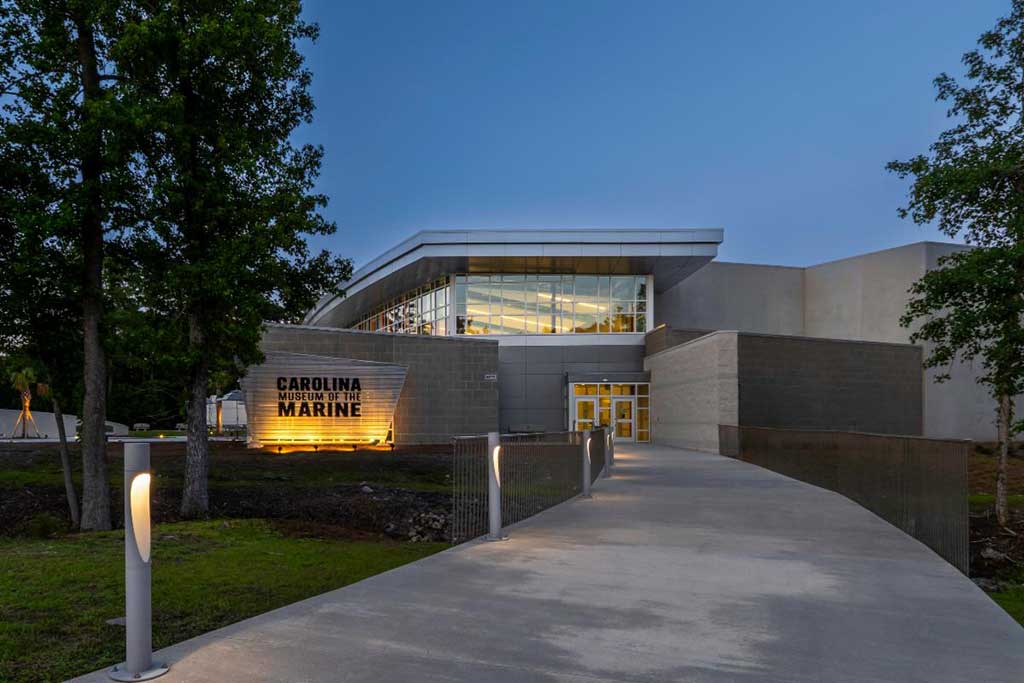
From there, the Museum moved through construction, exhibit fabrication and installation, operational planning, and the countless decisions and details required to open a new institution. On June 8, 2026, after more than a quarter-century of determination, the doors of the Carolina Museum of the Marine opened to the public.
That achievement belongs to far more people than can ever be named in one message.
Beginning with the Museum’s conceptual phase in 1999, legions of people stayed the course and kept this mission moving forward. They are retired service members and veterans, active-duty military, public servants, business owners, volunteers, civic leaders, donors, and citizens who believed this story deserved to be told. What began in Jacksonville has grown into a mission supported by people in every state and beyond.
I have the deepest admiration and respect for those who refused to quit—those who continued to give their time, resources, expertise, and encouragement through every challenge and every delay. The open doors of this Museum stand as a testament to their steadfastness.
I offer my sincere appreciation to the members of our Board of Directors. Their stewardship, counsel, and unwavering commitment sustained the organization through a demanding period of construction, transition, and opening. They also understood the continuing responsibility of securing philanthropic support for a private nonprofit institution—support essential not only to opening the Museum, but to ensuring its strength and sustainability for the future. They accepted the responsibility of guiding an institution built to endure, and their continued leadership will be vital as the Museum enters its next chapter.
I also offer my profound thanks to the Museum’s staff. They worked through the pressures of construction, exhibit installation, operational planning, and opening—often assuming responsibilities well beyond their formal roles. At the same time, they maintained the relationships, communications, programs, and daily work necessary to sustain the philanthropic support upon which this private nonprofit depends. They met each challenge with professionalism, resilience, and an abiding commitment to the mission. Their efforts made opening day possible, and their continued work is building the visitor experience and institutional foundation upon which the Museum’s future will depend.
Today, visitors walk through these galleries and encounter the stories of Carolina Marines and Sailors. They meet the individuals behind the history, learn from their example, and carry those lessons with them. That is why this Museum was built, and that is the mission we must continue to serve.
Finally, I offer my deepest thanks to my wife for her patience, encouragement, and unwavering support throughout this especially demanding chapter. As military families understand so well, service asks much of those waiting at home, and I remain profoundly grateful for all she has given.
Leading this organization has been one of the great privileges of my life. I will always hold profound respect for this community and for the people who made the Museum possible. Although my tenure as CEO is ending, my commitment to the Carolina Museum of the Marine is not. I will remain a steadfast supporter of its mission and its future.
It is my privilege to welcome Colonel Kipp Wahlgren, USMC (Ret), as the Museum’s incoming President and Chief Executive Officer. Kipp is a proven leader who understands the Marine Corps, the importance of preserving its legacy, and the responsibility entrusted to this institution. The organization and its mission will be in capable hands. I am confident he will be a strong champion for the Carolina Museum of the Marine as we celebrate the opening of its doors and build upon this extraordinary milestone.
It has been an honor to serve alongside all of you.
The mission continues.
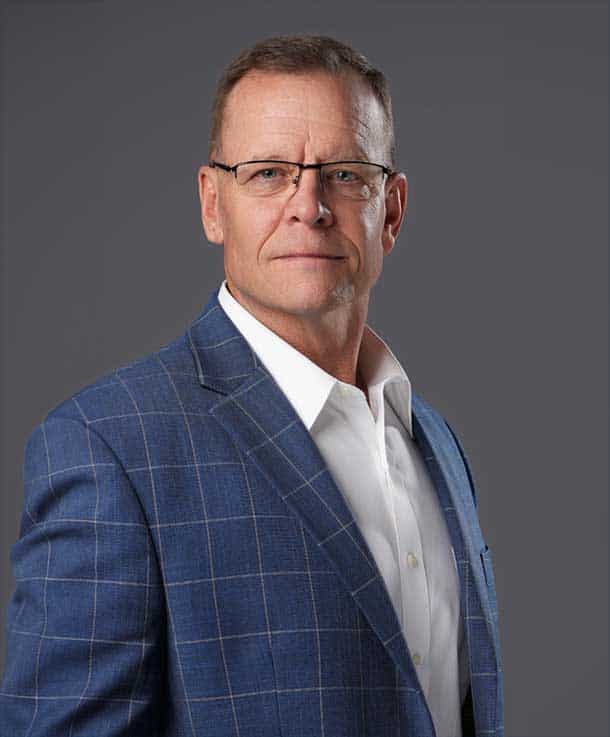
Semper Fidelis,
Joe Schrader
Major General, USMC (Retired)
President and CEO
THE MISSION CONTINUES
Welcoming Colonel Kipp Wahlgren, USMC (Ret)
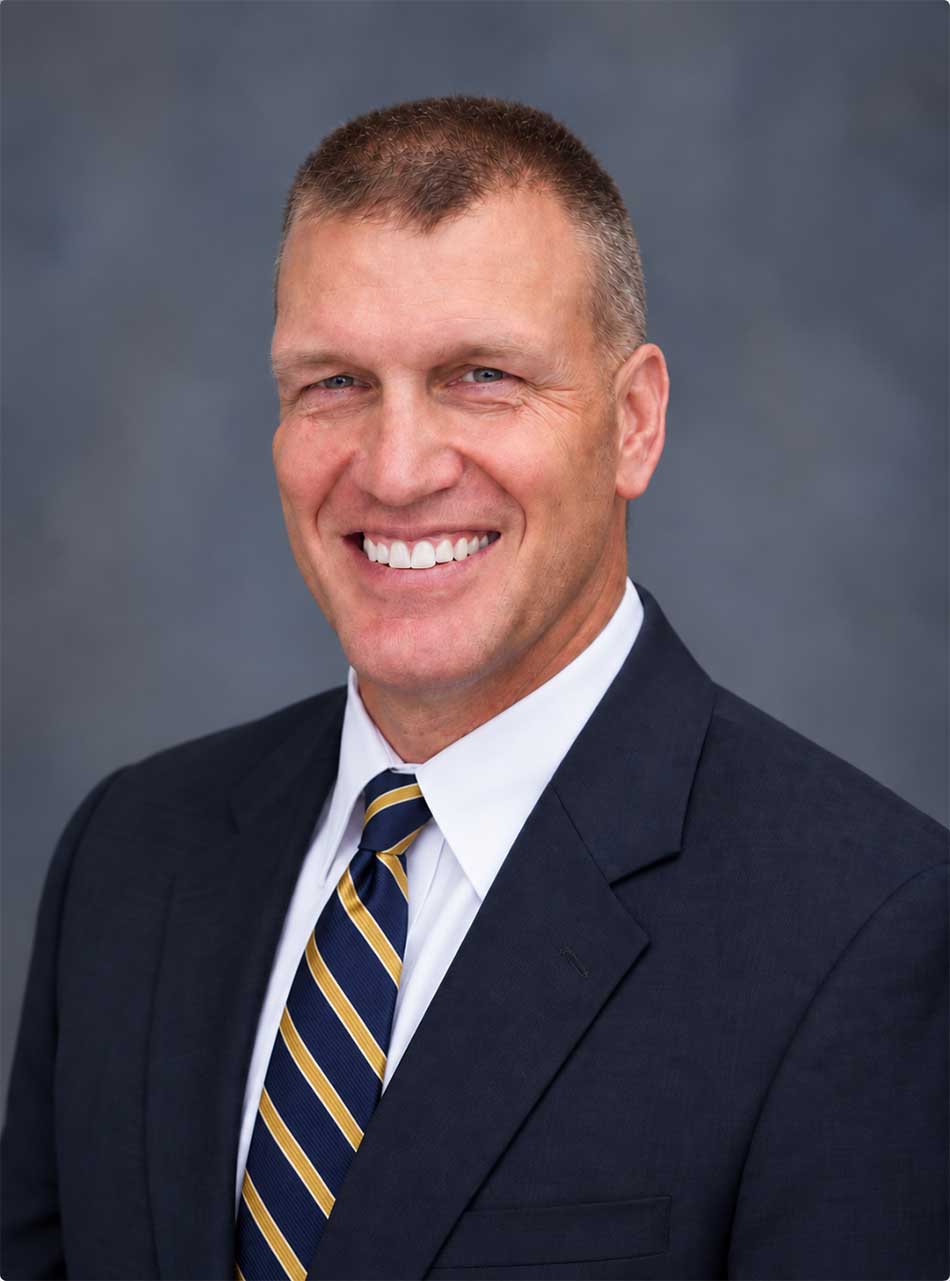
The Carolina Museum of the Marine is pleased to welcome Colonel Kipp Wahlgren, USMC (Ret), as its incoming President and Chief Executive Officer.
A 1995 graduate of the United States Naval Academy, Colonel Wahlgren served more than three decades in the Marine Corps. His career included three deployments in support of Operation Iraqi Freedom; serving as commanding officer of 3D Supply Battalion; strategic planning for Marine Forces Europe and Africa; helping establish Marine Force Storage Command; and serving as Deputy Commander of Marine Forces Korea. His most recent assignment was with 2D Marine Aircraft Wing at Marine Corps Air Station Cherry Point.
Colonel Wahlgren holds an MBA from Indiana University and a Master of Strategic Studies from the U.S. Army War College. He and his wife, Leasa, have two children. We look forward to welcoming Colonel Wahlgren to the Museum community as he leads the organization into its next chapter.
What Am I Seeing?
Pause. Look. Discover.
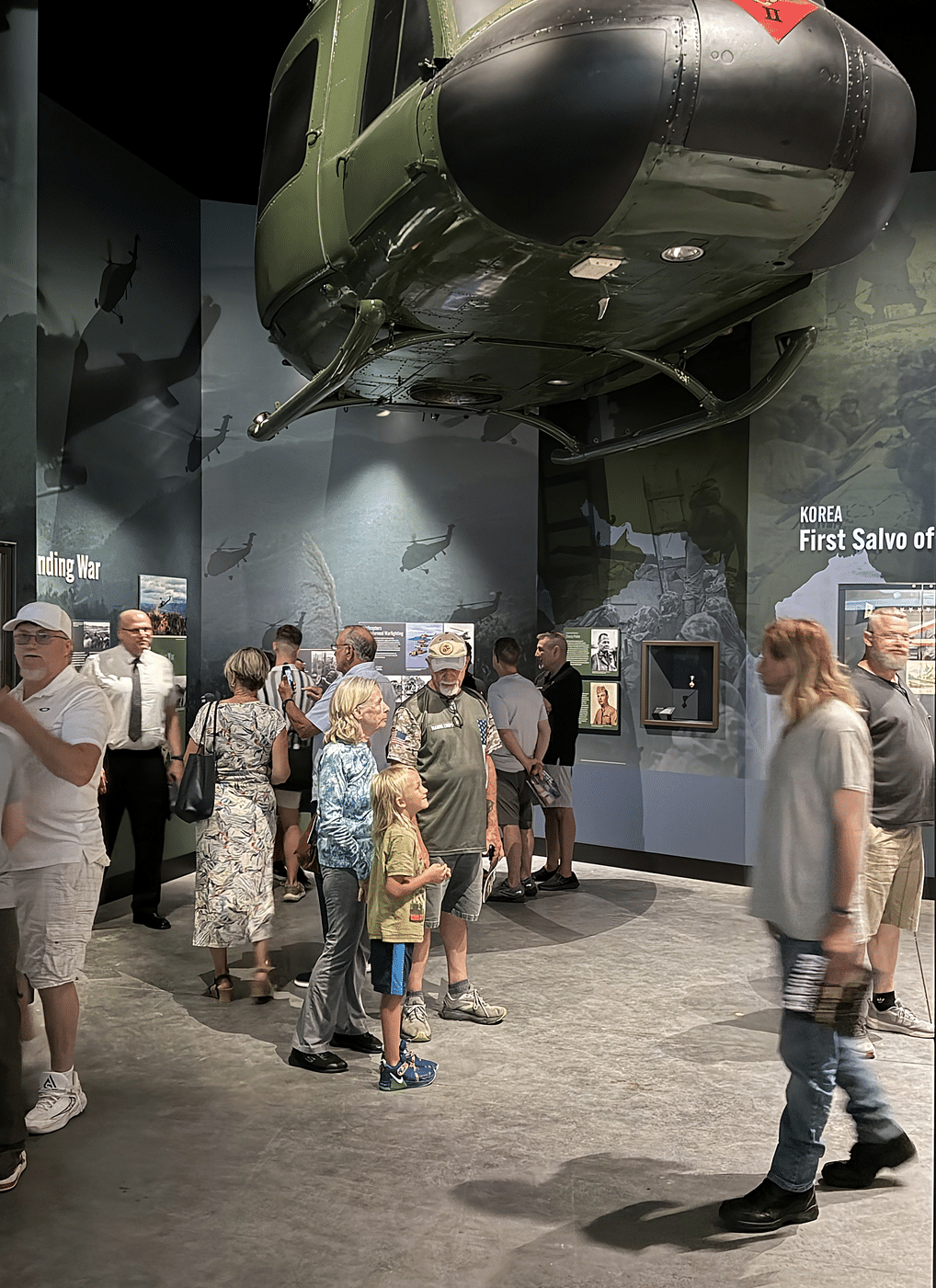
Photo by John Althouse.
Before entering Meeting New Challenges, look up.
Suspended overhead is one of the Museum’s most commanding sights: a Huey hovering above the gallery entrance. Its size, proximity, and familiar silhouette immediately change the atmosphere, signaling that visitors are moving into a new era of conflict, innovation, and service.
But the aircraft is only part of what makes this view so compelling. Beneath it, visitors of different generations gather, move, point, and look upward. Around them, historic images and interpretive panels begin to reveal the stories ahead. The gallery does not ask visitors simply to observe history from a distance—it places them within it.
This photograph captures the Museum as it was meant to be experienced: people encountering powerful stories together, each noticing something different and carrying away a perspective of their own.
The next time you visit, pause at this threshold. Look up, then look around.
What do you see?
Critical Thinking and Worldview
Jim Danielson, PhD
Marine Veteran · Retired Professor of Ethics
Some people are able, seemingly by nature, to reflect upon themselves asking about their strengths and weaknesses, and thus seeking to improve themselves regarding both. Some people find this nearly impossible to do. The first principle of Marine Corps leadership is to know yourself and to seek self-improvement. To do this, one must be able to examine himself closely and honestly. The nature of this examination, or perhaps we might say the focus of this examination, will change over time as someone grows because the focus of one’s concerns will change with personal growth. It is not controversial to observe that this process of knowing oneself and seeking self-improvement requires, among other skills, the ability to think carefully and critically. Here the nature of the process of knowing oneself and seeking improvement becomes substantially more interesting, and perhaps even more complicated, when we consider the place of worldview in the process of thinking.
Each of us has a collection of fundamental propositions about the world, ourselves, and how we got here that form the foundation of the ways in which we understand our reality. In general, people reason from the propositions of their worldview rather than to them, and for this reason many people fail to grasp that they see the world through the lens that is one’s worldview. This helps explain why we find ever more people who are easily offended and do not tolerate disagreement well. Often, when people speak on a topic or express disagreement with someone else’s position on a topic, irritation is incited because what is said challenges one of the tenets of a person’s worldview without the offended person understanding this as the cause of anger. Importantly, worldview is implicated in the nature of a cultural tradition since it is possible, for example, for two people to possess worldviews which are mutually exclusive to the point where it is nearly impossible for them to discuss serious subjects calmly and profitably.

[Illustration used under license – iStock]
The contents of one’s worldview will logically draw him to convictions about secondary and tertiary questions that comport with the originating worldview, and this helps us understand how it can happen that incompatible worldviews, when held by enough people in a society, can be damaging to a people’s cultural tradition. For example, we may acknowledge that either we human beings are created or we aren’t. There is no third possibility, so one of these two has to be true. This is important because whether or not we are created, and thus whether the world we live in is created, is perhaps the most fundamental tenet in someone’s worldview. The importance of one’s position on this question is evident from the friction that is occasioned by disagreements over it, and this is because one’s position on questions of fundamental concern sets the contours of one’s mind and character. Knowing oneself is thus crucial to self-improvement.
We are complex creatures, but for certain we have minds and wills, both of which need to be developed. So it is that how one answers the question of our creation, yes or no, will have an effect on how one addresses the question of whether the principles of morality, of ethics, are discovered or invented. This is so because if there is a creator, there is what we might call final truth, that is, the truth that is the genuine health of the mind because it is the truth about who we are as beings at once physical and spiritual, and why we are here. If there is no creator, then we appear to be alone in a universe that is indifferent to us and thus whatever meaning there is in life is meaning we must fashion for ourselves. Here again, it is easy to understand how disagreement on this fundamental question, whether morality is discovered or invented, can be culturally and socially unbalancing. It is easy also to see that one’s worldview has a direct impact on how one can think critically on matters great and small.
Here is a matter of some relevance to this discussion which should be mentioned without much commentary. On fundamental questions like whether we are created, and thus whether there is a God to whom we are beholden, people will advise that we take a neutral position so as not to alienate people who disagree either with a positive or a negative answer to the question. If, however, there is no third position, that is, either we are created or we aren’t with no third position for us to take, then we have no neutral position available. Typically, the consequence of following this advice is that people who believe we are created beings are made to speak and act as if they do not believe this. Even in an environment like this, however, people will hold to the basic tenets of their worldview, and thus a certain dishonesty is introduced in our relations one with another.

If the gaps among differing worldviews remain small, there isn’t much of a cultural problem from it since the tradition of the society remains largely undisturbed. However, when the tradition that has held a people together falls into a crisis of confidence, what role, if any can reason play in the restoration of a tradition. Up to this point, we have been discussing reason as critical thinking and the function of worldview in the activity, but it will be helpful to consider as we close the discussion what role reason can play when a tradition fails. In 1965, a scholar at the University of Notre Dame named Stanley Parry published an essay titled “Reason and the Restoration of Tradition” in which he discusses this issue of the role of reason in restoring tradition.[i] His answer begins in a tone that is less than encouraging: the role of reason in addressing the concern to restore or revitalize a tradition is negative. “It [reason] must purge itself of the arrogance that is an integral part of the crisis of tradition itself and return to a humble questing in the real world of being for whatever wisdom it may be able to wrest from that world.”[ii] This is but a snippet of a complex argument but it captures the essence of what Parry is saying about the role of reason in the restoration of tradition. In Parry’s analysis, the cause of crisis and debility in a tradition may have multiple contributing factors, but Parry gathers them together under the heading of hubris.
It is this outsized pride that causes people to think that we can improve conditions in society by taking aim at the core convictions of the cultural tradition and begin dismantling them. It becomes clear after a while, however, that this approach causes harm with little in the way of offsetting benefit. Moral reasoning has a subjective element to it, namely, the person doing the reasoning, and the quality of one’s moral reasoning is determined by the moral quality of one’s character at any given time. Thus as we grow as human beings, our inner moral world improves and we become better reasoners. “In the inner moral world man can construct realities that are not morally true.”[iii] It is this possibility, often even probability, of constructing false inner moral “truths,” especially in a time of crisis in a tradition, that leads Parry to argue that in such a time the role of reason is humbly to examine ourselves and our world for truths that once were understood, but the understanding was lost with the tradition that understood them. We must be re-united, Parry argues, with the source of meaning, and this takes us back to the important question of the role of worldview in critical thinking. Perhaps a close examination of one’s worldview is a helpful place to begin for anyone who is interested better to know himself, and to seek self-improvement.
[i] Stanley Parry, “Reason and the Restoration of Tradition,” What is Conservatism, Edited by Frank S. Meyer, Holt, Rinehart and Winston, New York, 1965, Pp. 107-129.
[ii] Ibid., P. 109.
[iii] Ibid., P. 111.

Need Something? We’ve Made It Easier.
We’ve introduced dedicated email addresses to help connect you with the right member of our team. Whether you’re planning a visit, joining as a member, or supporting our mission, we’re here to help.
Planning a visit?
Hours, accessibility, parking?
Call 910-275-4408 or email
visit@museumofthemarine.org
Tours or Field Trips?
Membership questions?
Join, renew, replace a membership card, or update your information.
membership@museumofthemarine.org
Support the Museum
Donations, sponsorships, naming opportunities, and planned giving.
giving@museumofthemarine.org
Volunteer?
Learn about volunteer opportunities and how to get involved.
volunteer@museumofthemarine.org
Planning an event?
Rent the Great Hall, a classroom, or the entire museum for your special event.
RentTheMuseum@museumofthemarine.org
Media and Marketing
Interviews, press, photography, or promotional requests.
media@museumofthemarine.org
General Questions
We’re happy to help.
info@museumofthemarine.org
Copyright September 2026. Carolina Museum of the Marine
2025-2026 Board of Directors
Executive Committee
LtGen Mark Faulkner, USMC (Ret) – Chair
CAPT Pat Alford, USN (Retired) – Vice Chair
Mr. Mark Cramer, Esq. – Secretary
Vacant – Treasurer
Col Joe Atkins, USAF (Retired)
LtGen Robert “Fuzzy” Hedelund, USMC (Ret)
MajGen Jim Kessler, USMC (Ret)
Col Bob Love, USMC (Ret)
The Honorable Robert Sander, Former General Counsel of the Navy
MajGen Joe Shrader, USMC (Ret), President and CEO, Ex Officio Board Member
In Memoriam: General Al Gray, USMC (Ret)
Members
Mr. Mike Bogdahn, US Marine Corps Veteran
MGySgt Osceola “Oats” Elliss, USMC (Ret)
Col Bruce Gombar, USMC (Ret)
LtCol Lynn “Kim” Kimball, USMC (Ret)
Richard McIntosh, USMC (Ret)
LtGen Gary S. McKissock, USMC (Ret)
Ms. Sandra Perez
Mr. Phil Randall, US Marine Corps Veteran
Mr. Cliff Renchen, US Marine Corps Veteran
Mr. Billy Sewell
Col John B. Sollis, USMC (Ret) – Emeritus
Col Grant Sparks, USMC (Ret) – Emeritus