Thoughts on D-Day (6 June 1944)
by LtCol Lynn “Kim” Kimball, USMC (Ret)
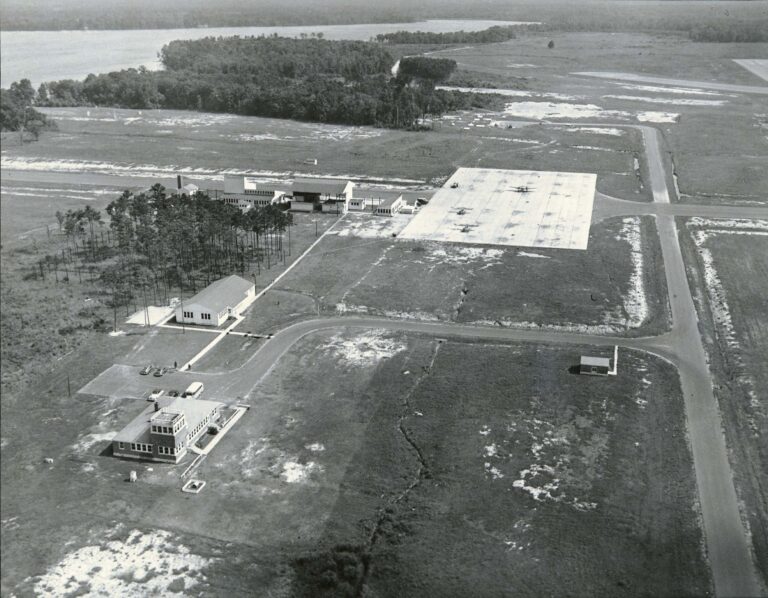
The Duke of Wellington once famously stated that the Battle of Waterloo was won on the playing fields of Eaton. It can be equally said that victory in World War ll was likewise achieved in many respects on, above and inland from the beaches of Onslow County, here aboard Camp Lejeune.
The Marine Corps pioneered in the 1930s what is considered to be the greatest tactical innovation of the 20th century, the amphibious warfare doctrine that would take Allied forces victoriously over every beachhead in WW ll. Camp Lejeune, the Marine Corps’ largest amphibious training base, was instrumental in developing, testing and refining that doctrine. Elements of five Marine divisions would train here during the war, as well as tens of thousands of other Marines, whose storied and heroic battles in the Pacific are well documented. Of particular interest to the date being commemorated, however, is that Camp Lejeune trained the U.S. Army’s 1st and 29th Infantry Divisions in amphibious warfare.
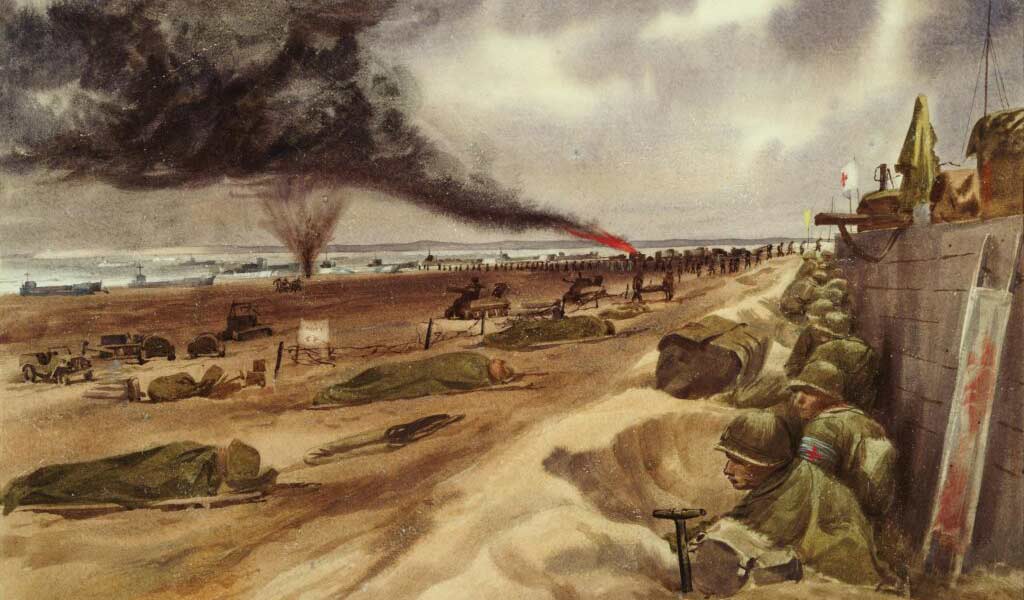
On 6 June 1944, D-Day at Normandy, France, Allied forces stormed onto the continent of Europe in a victorious and decisive assault that would precipitate the downfall of Nazi Germany. Spearheading that assault across Omaha Beach was the Army’s oldest division, the 1st Infantry Division, the “Big Red One,” which was accompanied by the 29th Infantry Division in the subsequent breakout from the coast.
The 1st Infantry Division began its training at Camp Lejeune with the 1st Marine Division during the summer of 1941, only a month after base’s beginning. The 1st Inf Div was followed by the 9th, which trained here for two months. Both Army divisions later used their Camp Lejeune-taught amphibious skills in the landings at North Africa and Italy. Their major test, though, was at Normandy on D-day, where their success was in no small part due to the training they received here.
Marines, incidentally, were at Normandy, but only in small numbers, a total of 306, principally because the Joint Chiefs of Staff but decreed that Europe was going to be an Army theater. It’s also been reported, somewhat anecdotally, that General Eisenhower had complained that if he had let the Marine Corps participate, they would have taken credit for the success of the entire operation.
It should additionally be noted that the training of the Army’s 1st and 9th Inf Divs wasn’t Camp Lejeune’s only contribution to D-Day. The U.S. Coast Guard, which arrived at Camp Lejeune with the 1st Marine Division in 1941, established its only landing craft school here, eventually at Courthouse Bay, where it stayed for five years, training landing craft crewmen in the most difficult and dangerous phase of an amphibious assault, the actual projection of the landing force on a hostile shore. Coastguardsmen manned more than 2000 landing craft in every major operation, both in the Atlantic and Pacific, and were significantly present at Normandy.
As the images of the waves of landing craft assaulting the beaches come to mind, some bullet-torn and exploding, it should be remembered that many of their crews, as well as the embarked soldiers, were trained at Camp Lejeune. Camp Lejeune was indeed at Normandy.