Education for a Good Society

A 1991 issue of United States Marine Corps: Concepts and Issues, published when General Gray was commandant, begins with this statement of purpose: “Concepts and Issues provides a brief description of how the Marine Corps is organized, what particular contributions the Marines make to our national defense, and those steps taken by the senior leadership of the Department of the Navy to ensure that our naval expeditionary forces continue to be prepared to meet the challenges of the 21st century.” The document is brief, as the opening statement tells us, but it is nevertheless a wealth of information with no small amount of detail. On page 2-19 of the document, we read the following: “The Marine Corps’ most potent answer to an unpredictable and turbulent future is the individual Marine. Our top most priority has therefore been to recruit and retain the very best active and reserve force that American society has to offer.” This is a very clear statement of the potent truth that the quality of individual Americans is important for the quality of the Marine Corps, and in fact, for families, schools, communities, and every other aspect of a healthy society.
In Republic, and elsewhere, Plato asserts that no society can be just whose citizens are inwardly unjust. By this Plato meant that a society in which people are able to flourish as human beings is one in which the members of the society have well-ordered souls. This might appear to be saying that a society in which human beings may flourish as human beings is one in which human beings do flourish as human beings. The fact that this is true attests to the importance among a people of a living cultural tradition in which the benefits of the tradition are passed from one generation to the next through family, religion, and education. Importantly, education is not the work of schools alone, but of schools working in tandem with families. Ideally, the formation of well-ordered souls is understood in a society to be the primary work of the family, and this is why education of the young among ancient Athenians was training in the habits of goodness, or virtue. The idea was that when we train children to behave virtuously and to think skillfully, then when they reach the age of reason and can truly think things through on their own, they will understand why they were educated as they were, they will not have bad habits to overcome, and importantly, they will already be on the path of guiding their lives according to truth and principle.
This understanding of education did not die with the Athenians. In the early Middle Ages we see the beginnings of a similar kind of education in the writings of a Roman senator and philosopher known generally as Boethius. In time, the methods of education that developed were known as the trivium and the quadrivium. The trivium is comprised of grammar, logic, and rhetoric. These disciplines trained young minds to think carefully and skillfully and to speak with clarity and confidence. The study of grammar teaches students to understand the structure of their language and to appreciate writing that is well-crafted. Logic brings discipline to the mind and empowers the student to identify faulty arguments when he hears them. Rhetoric was the art of speaking skillfully and persuasively. Aristotle wrote an influential treatise on rhetoric in which he divides a presentation to an audience into three parts: ethos, logos, and pathos. Ethos is the part of a discussion in which the speaker seeks to convince the hearers that he is qualified to speak on the topic. Logos is the actual argument or explanation, and pathos is the attempt by the speaker to help the hearers identify affectively (similar to “emotionally,” but not quite) with the argument.[i] In all of this, the underlying understanding is that when one undertakes to speak to others, he has the obligation to speak honestly. One might be mistaken, but a mistake is not a lie, and mistakes can be identified and corrected in honest conversation.
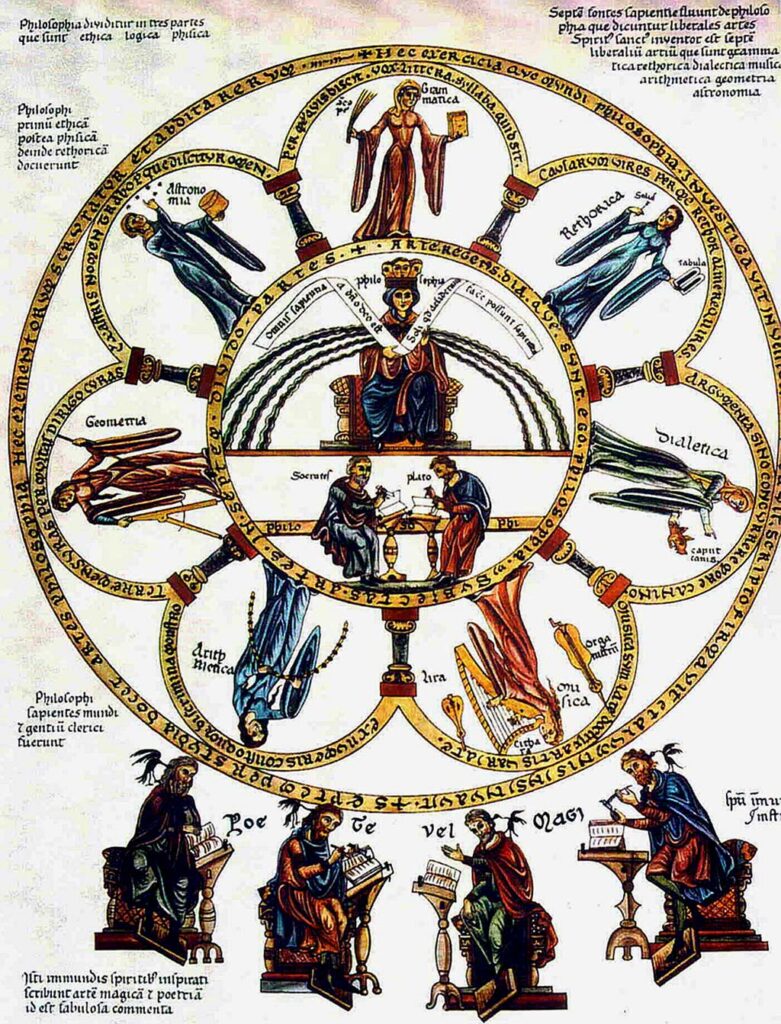
he quadrivium is comprised of arithmetic, geometry, music, and astronomy. The study of arithmetic and geometry were intended primarily to train the mind to think abstractly, since this skill is needed in order to think and to analyze things deeply.[ii] The study of music is the study of the relationships of measure, form, and order to beauty. This is important as part of the pursuit of what was taken to be what the mind most needs to know: the good, the true, and the beautiful. The study of astronomy seeks to help the student understand the order of the heavens as a depiction of the realm in which he lives. As above, so below.
The idea both among the Athenians and the Europeans of the Middle Ages was that when we train people from childhood in the habits of goodness, and this includes training their minds to think with discipline and skill, we ensure at the same time that our societies will be much better for it. This takes us back to the quote above from Concepts and Issues that the topmost priority of the Marine Corps is to recruit and retain the best people American society has to offer. The idea of education and society discussed here is able to raise and prepare people the Marine Corps can train to be warriors for the defense of our country that no enemy will want to encounter. Such people would arrive at basic training already practicing the first principle of Marine Corps leadership to know yourself and to seek self-improvement. Such people also would be ready to fulfill General Gray’s admonition that we have to “out-think the other guy”.
The Al Gray Marine Leadership Forum at Carolina Museum of the Marine seeks to use the lessons and examples of the Marine Corps to help Americans at large grow as human beings. This will improve their lives and families, and our society. It will also ensure that those Americans who are the best that American society has to offer will be very good indeed.
[i] We sometimes hear in a discussion something like this. A person makes an argument about the form of government found in the Constitution of the United States and the other person says: “You can’t say that because you didn’t go to law school.” The person making this reply has made the mistake of confusing the ethos part of a presentation with the logos part.
[ii] Plato insisted that no one who hasn’t mastered geometry should be allowed to study philosophy before the age of fifty, because it takes a life that long to learn to think abstractly without the study of geometry.