When in the Course of Human Events: The Declaration of Independence at 250
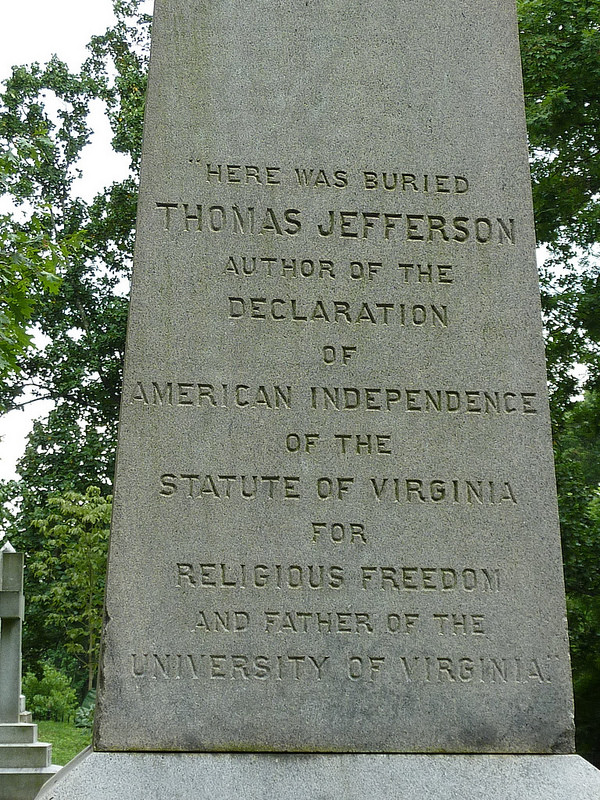
Bob, CC BY 2.0 , via Wikimedia Commons
It is well known that Thomas Jefferson is the principal author of the Declaration of Independence. Jefferson’s gravestone at Monticello reads: “Here was buried Thomas Jefferson author of the Declaration of Independence, of the Statute of Virginia for Religious Freedom, and Father of the University of Virginia.” It seems that Mr. Jefferson was prouder of having written the Declaration of Independence than he was of having been president of the United States. Thomas Jefferson died on July 4, 1826, 50 years after the publication of the Declaration. On the 4th of July this year, 2026, Americans will celebrate 250 years of independence from Britain, and it will have been 200 years since Thomas Jefferson died. It seems a fitting exercise, therefore, to consider our Declaration of Independence with attention to the concept of independence that is defended there.
The opening paragraph of the Declaration states its purpose eloquently: “When in the Course of human Events, it becomes necessary for one People to dissolve the Political Bands which have connected them with another, and to assume among the Powers of the Earth, the separate and equal Station to which the Laws of Nature and of Nature’s God entitle them, a decent Respect to the Opinions of Mankind requires that they should declare the causes which impel them to the Separation.” We may observe at first the assumption, suggested by Jefferson’s tone, that settled political arrangements should not be changed lightly.[i] This is verified a little later when Jefferson writes that “…all Experience hath shewn, that Mankind are more disposed to suffer, while Evils are sufferable, than to right themselves by abolishing the Forms to which they are accustomed.” Freedom is important to human flourishing because it is our nature to be free, and because growth as a human being happens when one freely chooses it, and pursues it. We have occasion, not infrequently, to recall the first principle of Marine Corps leadership: “Know yourself, and seek self-improvement.” We can and should acknowledge the importance of freedom to human happiness, but we should acknowledge also the importance of order as the necessary guide to the beneficial uses of freedom. This is discussed interestingly by Russell Kirk at the opening of his essay, cited above, titled “Prescription, Authority, and Ordered Freedom:” “Civilized man lives by authority; without some reference to authority, indeed, no form of human existence is possible. Also man lives by prescription—that is, ancient custom and usage, and the rights which usage and custom have established. Without just authority and respected prescription, the pillars of any tolerable civil social order, true freedom is not possible.”[ii]
This important balance between order and freedom is what Jefferson is referring to when he observes that experience has shown us that people will suffer evils while they are tolerable, but lying behind this observation is the very American assertion, soon to be made clear, that sovereign governing authority lies with the people who are governed.[iii] It is possible, however, for people to be pushed by a government to the place where evils are no longer tolerable. This is the “tipping point” Jefferson identifies when he writes: “But when a long Train of Abuses and Usurpations, pursuing invariably the same Object, evinces a Design to reduce them under absolute Despotism, it is their Right, it is their Duty, to throw off such Government, and to provide new Guards for their future Security. Such has been the patient Sufferance of these Colonies; and such is now the Necessity which constrains them to alter their former Systems of Government.” This quote is taken from the second paragraph of the Declaration which appears just after Jefferson expresses, in one sentence, the essence of the American theory of government, which, in the spirit of celebrating 250 years of the Declaration of Independence, we will air in full.
“We hold these Truths to be self-evident, that all Men are created equal, that they are endowed by their Creator with certain unalienable Rights, that among these are Life, Liberty, and the Pursuit of Happiness—That to secure these Rights, Governments are instituted among Men, deriving their just Powers from the Consent of the Governed, that whenever any Form of Government becomes destructive of these Ends, it is the Right of the People to alter or to abolish it, and to institute new Government, laying its Foundation on such Principles, and organizing its Powers in such Form, as to them shall seem most likely to effect their Safety and Happiness.” I’ve counted the number of words in this sentence several times and finally turned to other pursuits having failed to count the same number twice. However, there are more than 100 words in this long sentence which is a compact recitation of the form of government that had developed in British America during the colonial period. There are various ways of explaining how the development of our federalist governing order arose, for example the beneficial effect of the “benign neglect” from London on the colonies, but the heart of it is clear.
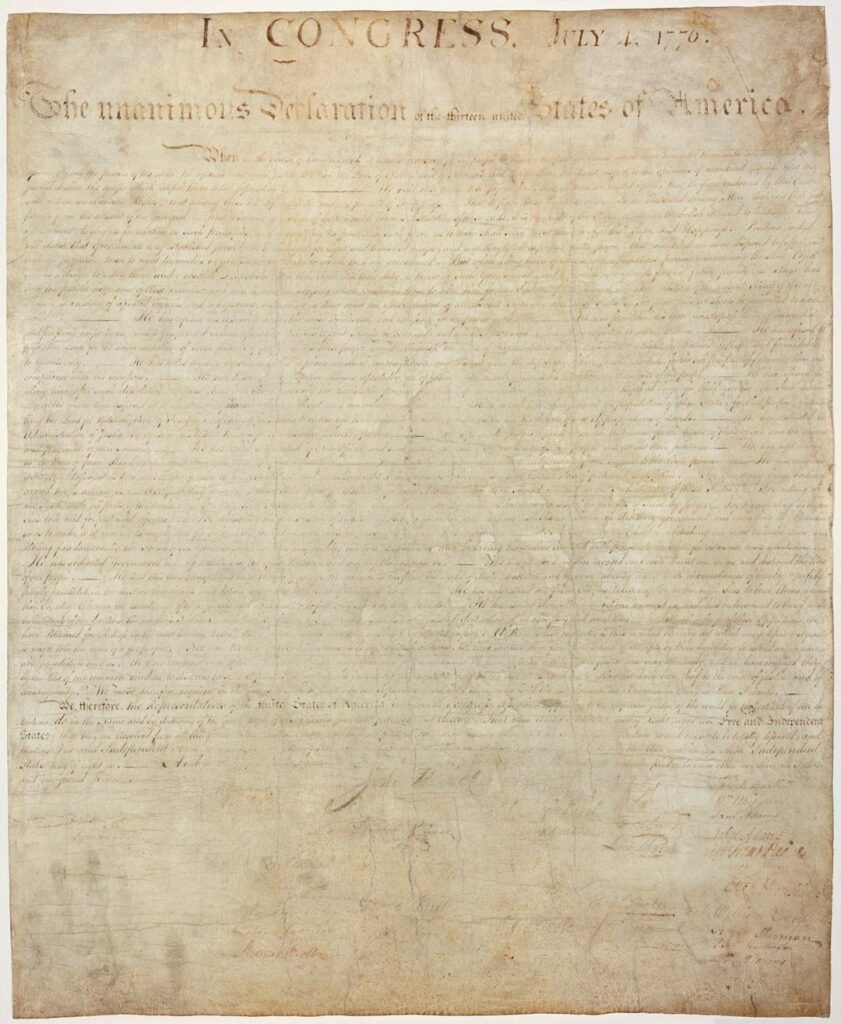
https://www.archives.gov/founding-docs/downloads. Transcript available here: https://www.archives.gov/founding-docs/declaration-transcript
The concept of sovereignty may be understood as the right to govern without the permission of anyone else. This idea was first announced and explained by Jean Bodin in 1576 in his work Six Books of the Republic. The idea of sovereignty tracks closely with the rise and development of that modern form of government called the state.[iv] The concept of sovereignty as it first appeared was held to be a property of government in each state, for example, England, Germany, and Italy each have sovereign governments and so the people of each state are properly considered subjects of their government rather than citizens. In British America the idea developed that sovereignty is the possession of the people of each colony and later of each independent state. The idea is that the people of a state, like North Carolina, exercise their sovereign authority through their elected legislature, and in turn, it is the duty of the legislature to protect the rights of the citizens of the state. Thus, and this is what Jefferson asserts in paragraph two of the Declaration, whenever a government becomes destructive of the ends for which it is established, protecting the rights of citizens, it is the right of the people, as sovereign authority, to alter or to abolish that government.
There is an important point here to consider, and as with any idea of importance or complexity, there will emerge differing interpretations of what it means. (This is one of the importance reasons for people to listen to one another in conversation.) By 1776, the thinking goes, the thirteen colonies of British America had become mature political societies with their own customs, traditions, and ways of governing themselves, and therefore they each had the right to act independently of the Mother Country as free, sovereign, and independent states, much as children, upon reaching adulthood, are no longer under the authority of their parents. The states were not copies of one another but were different one from another. For example, of the first five presidents of the United States, four were Virginians: George Washington, Thomas Jefferson, James Madison, and James Monroe. Beginning with Jefferson’s first inauguration in March of 1801, the United States had a period of 24 years in which there was a Virginian in the White House. Moreover, all four of these presidents served two terms while the one northern president among the first five, John Adams of Massachusetts, served only one term in office. There was much talk in those years among northern leaders of leaving the union under the Constitution and forming their own northern union. It seemed to many in the North that the South would forever dominate the Union, and they didn’t like it. Culturally, the North and the South were different. The point to consider, alluded to at the beginning of this paragraph, is that each place has its own history, and thus a form of government that works well for one people will likely fail when introduced to another.
Here again, Russell Kirk makes the point well. “The American and British constitutions have worked well; but, being living essences, they cannot easily be transplanted to other states. One of the cardinal errors of the French revolutionaries was their endeavor to remake France upon the model of what they thought English politics to be. Though any people have something to learn from the experiences of any other, still there exists no single constitution calculated to work successfully everywhere. For the political institutions of a people grow out of their religion, their moral habits, their economy, even their literature; political institutions are but part of an intricate structure of civilization, the roots of which go infinitely deep.”[v] Americans of the generation that broke with the British Empire knew that each American state had its own history and culture despite the similarities of common origin, religion, and language, and thus they wanted a limited kind of union for mutual defense and trade, at first, anyway.
Having enumerated the many abuses and usurpations of the British government upon the American colonies as the reasons justifying the separation, the Declaration finishes firmly and eloquently, reminding us why we celebrate our independence. “We, therefore, the Representatives of the united States of America, in General Congress, Assembled, appealing to the Supreme Judge of the World for the Rectitude of our Intentions, do, in the Name, and by the Authority of the good People of these Colonies, solemnly Publish and Declare, That these United Colonies are, and of Right ought to be, Free and Independent States; that they are absolved of all Allegiance to the British Crown, and that all political Connection between them and the State of Great-Britain, is and ought to be totally dissolved; and that as Free and Independent States, they have full Power to levy War, conclude Peace, contract Alliances, establish Commerce, and to do all other Acts and Things which Independent States may of right do.—And for the support of this Declaration, with a firm Reliance on the Protection of divine Providence, we mutually pledge to each other our Lives, our Fortunes, and our sacred Honor.”
[i] This point is discussed with great skill by Russell Kirk in “Prescription, Authority, and Ordered Freedom,” which appears in a collection of essays titled What is Conservatism?, edited by Frank S. Meyer, Holt, Rinehart and Winston, New York, 1965, Pp. 23-40.
[ii] Ibid., P. 23.
[iii] There is much to be said about this American idea of self-government, called federalism, but it develops from the reality that each colony of British America was chartered by the Crown independent of the others. Moreover, the colonies were settled by people from various parts of Britain and developed differing political and cultural orders. [This fact is captured brilliantly and developed by David Hackett Fischer in Albion’s Seed: Four British Folkways in America.] This is why American ideas of healthy social order included the insistence that the authority to govern is lodged in the people of each colony, and later each state.
[iv] The state is a modern form of government generally held to have emerged fully in the Treaty of Westphalia in 1648. Often one will hear the question: “What about the Greek city-state?” The phrase “city-state” is a mis-translation of the word “polis,” which may be understood as meaning “city,” or “the place where our people live together.” The word “polis” has no possible implication of the word “state.”