Remarks at a Milestone on Our Journey
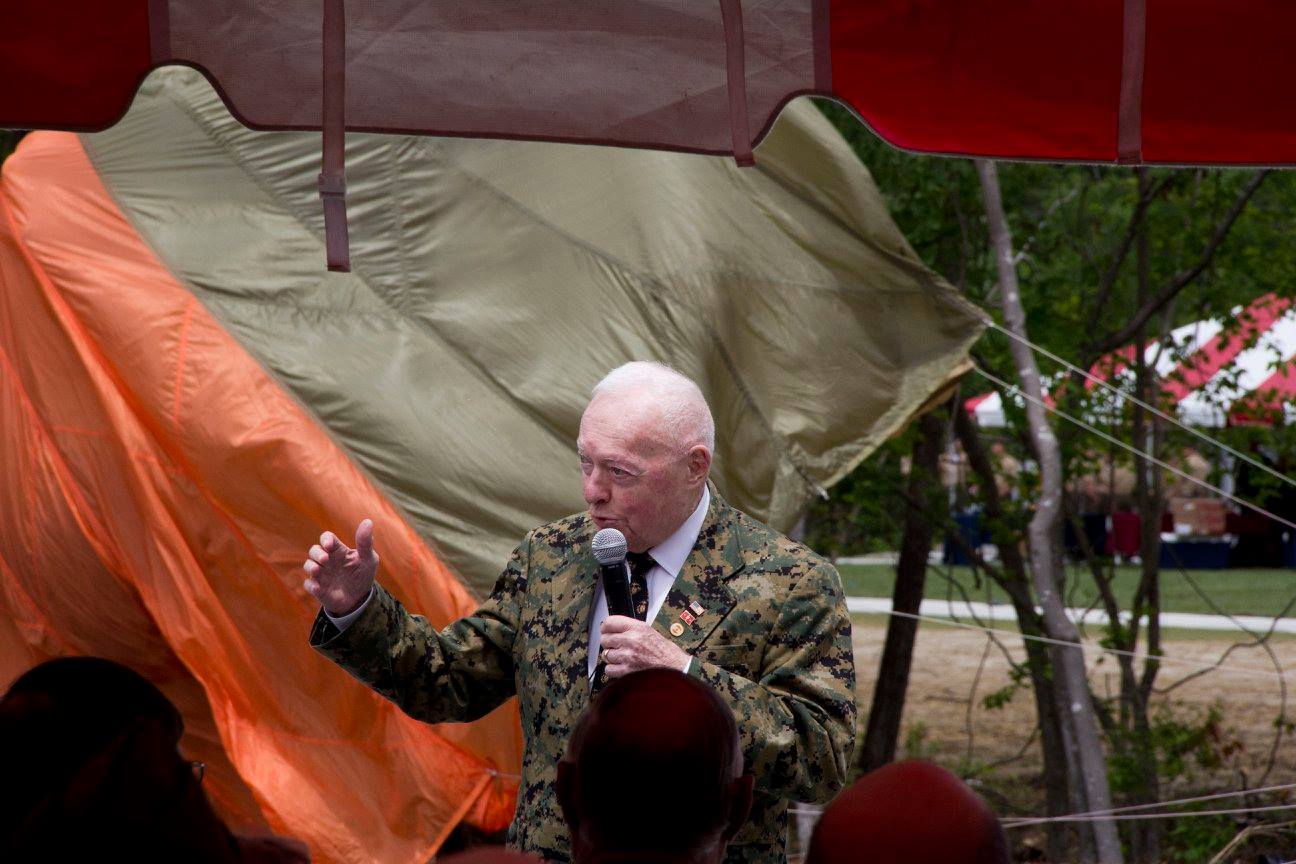
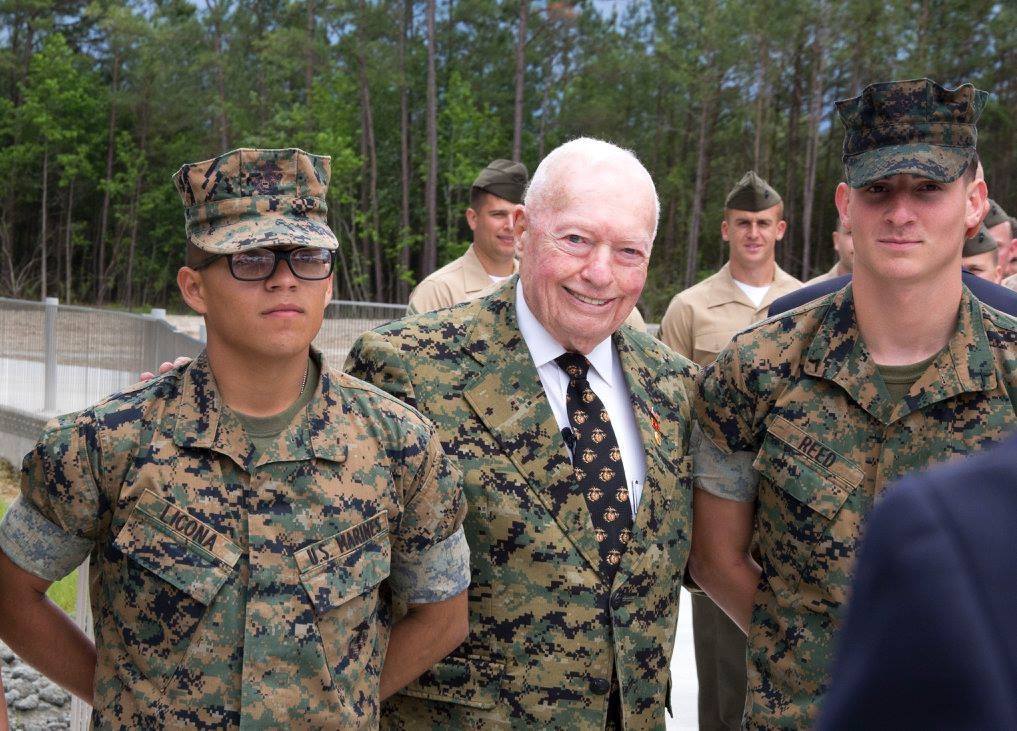
On 6 May 2016, the Reflection and Celebration Park in Lejeune Memorial Gardens was dedicated at what is now Carolina Museum of the Marine. Dedicatory remarks were given by General Al Gray who began by saying: “Thank you for the great introduction and more importantly for the opportunity to come back home to the place that’s very close to my heart and my wife Jan’s heart and it’s great to see so many of you and it’s just great to be with you and it’s particularly a privilege to participate in this dream…reality….
The idea of having a museum for the Marines and talking about the Carolina Marine Air Ground Task Force, which is really an air ground logistics team under a single commander, that is just I think phenomenal and it is one I believe that will go down in history as something you’re all going to be proud of and you’re all going to be proud of being part of it. The Carolina MAGTF idea really has its genesis in Feb. 1954 when the then Commandant Gen Shepard made the statement that we really need to think about being a Marine air ground task force, we really need to be a Marine MAGTF, if you will. We have long been the experts in Close Air Support and in supporting ground troops and all that. That was our heritage, that’s what we did. But he said that we’ve got to put it together now, particularly with Marine air groups, and ground troops and of course the logistics people that make it all happen, and again under a single commander. And so they came up with something they called the 2d MAGTF and it was located here in Camp Lejeune. And it had its first exercise in April 1954 and the like where they began in concert with the Navy to think through these concepts and think through these ideas which eventually became doctrine.” General Gray delivered these remarks about seventeen years after the idea was first formulated of a museum to remember the achievements and contributions of Carolina Marines and Sailors. But in May of 2016, the museum remained an unattained goal. Today, Carolina Museum of the Marine is an achieved reality that will open to the public on Monday 8 June 2026.
As General Gray continued his comments, he said: “When they refined the helicopter doctrine actually it started in 1948 and of course came to fruition in Korea and the like but the real idea of landing from ships to go ashore and land by helicopter that idea really came about a little bit later and the very first helicopter landing carrying troops from ship to shore happened here at Onslow Beach, under Colonel Keith McCutcheon, who later became a general, head of aviation, but these are the historical kinds of things that we can go back to and we can bring up if you will in terms of the museum and the thinking and concepts and the like. As you know we developed the Harrier aircraft along the way in the late 50s and 60s and people like Gen Miller the old aviation commander and the like flew the first Harriers in England but the very first testing of the Harrier concept in 1972 where company commanders and battalion commanders would go up to pilots in the field and tell them what they needed and the pilots would take off and run the mission. The very first concepts were tested here in the spring of 1972 right here at Camp Lejeune. That’s just one more historical kind of thing that happened.”
As Gen Gray continued speaking he developed, rather like a collage, a picture of the accomplishments of Carolina Marines and Sailors, at times in cooperation with west-coast Marines, that constitute the ongoing history that Carolina Museum of the Marine exists to remember. “Also in 1972 the very first large brigade exercise was held at 29 Palms and that one consisted primarily of forces from Camp Lejeune, Cherry Point, New River, and Beaufort, SC, as well as from the west coast. It was the first time that the Marine Corps had put Marines from the Pacific command if you will and Marines from the Atlantic command together at 29 Palms and they ran the first brigade-sized, mechanized exercise. Marines from the 2d Marine Division using the old amtracs, the LVT-5s, remember those, they’re almost as old as you, right? They were so old that when you ran them around twenty miles or so, they were so hot that you could fry an egg on the hood of the amtrac. But this exercise they took these amtracs with Marine warriors 60 miles the first day in the desert. It was the first large scale mechanized kind of a thing we had ever done really and it paved the way, set the scene for later operations in NATO and the like where we had to conduct these kinds of operations.”
One interesting element in General Gray’s discussion of the Carolina Marines and Sailors is bringing into light the fact that the Carolina MAGTF has developed its capabilities over time and in ways that make Marines ever better at what the Corps exists to do. “In 1976 the Commandant, General Wilson, who was awarded the Medal of Honor on Guam, was adamant that we could demonstrate to the world that we were in fact a good capable force that could reinforce NATO in Europe. We had been criticized and we had really not done very well over there. Technically we were the strategic reserve for NATO in those days with the 82nd Airborne. But people really didn’t know what the MAGTF could do, what it was really capable of doing. And so he formed the first permanent Marine brigade since WWI, the 4th Marine Amphibious Brigade, and he formed that force and he gave it the mission of making sure that Europe and everyone else our allies knew just how good we could be and what we could do and how we would use our air and show the Air Force and everyone else how we employ our air under a single commander. And what did he do he chose forces from Camp Lejeune, Cherry Point and Beaufort, the Carolina MAGTF, to make this happen and they did in 1976, 1977, 1978 and the rest of the 70s and 80s he made the Marine Corps totally valuable if you will to our European allies and the like.”
When he turned his attention to a discussion of maneuver warfare, General Gray proved that the Carolina MAGTF, for all its skill and capability, has also a sense of humor. “But it was really here at Camp Lejeune where the whole maneuver warfare thought process took place. And it was the young Marines, officers, Sailors and the like of the Carolina MAGTF that made it happen. They conducted for several years three types of exercise and the like. The idea was not to have approval from higher headquarters. The idea was to make it happen on the ground here because if you get the higher headquarters involved it’s likely to get disapproved. Higher headquarters is your natural enemy. You younger Marines out there in the audience still on active duty remember this: never provide any gratuities to higher headquarters, simply answer the question as quickly as you can. That was always my theme and it was very successful, except when I became higher headquarters, then I stopped saying it, but that’s another topic. But the point I want to make is that we sold the idea in the field, first in the Carolina MAGTF and later throughout the Corps. And I’ll tell you how it worked. One day, for example, we did a lot of exercises at Ft Pickett, and we were doing free maneuvers, they were all free maneuvers, you had to get your own intelligence, had to do your own thing, had to hold your own critiques and the like. We were at Ft Pickett and were teaching how to break out of an encirclement. The way you do that is of course, the unit on the inside, the one being encircled, puts reconnaissance units out in a 360-degree circle if you will. They look for openings and the like. And in this particular scenario, and I think you’ll recall this General Smith, the 8th Marines were encircled. They had a battalion, their headquarters, and some other forces. They were surrounded by a tank battalion, and a couple of other battalions and the like. The Regimental S-3 was a young tough major who really didn’t believe much in the maneuver idea, but he was a good officer, had won the Navy Cross in Vietnam and the like, a good tactician and all. You know him, right? And, anyway, he was the 3, and these recon units were out on the perimeter. One of the recon teams called in and said we’re here at checkpoint 16 and there’s no one here. So, Major Smith picked up the radio and said the focus of main effort is now thru checkpoint 16, go, and the whole force escaped encirclement. That’s the day Major Smith became a true believer. Little by little we were getting these key people, of all ranks and grades, whether corporals or generals or whatever, and they were beginning to understand that it really works. And Ray later, after the Beirut attack and the like, Ray went to Beirut and the like to relieve that force but first had to go to Grenada and it was his battalion that took 8 of the 10 objectives on the island of Grenada on the way to Beirut. I still have the 3×5 card, Ray, that you sent me from that deployment and it says, man this stuff really works, Ray Smith. I still have it on my desk and whenever I have doubters and nonbelievers, I break it out, and brag about you a little bit. So these are the sort of things that went on in the Carolina MAGTF and I could go on and on and on about the different lessons and the like. If you fast forward after I retired, I had nothing to do with it, the magnificent performance of our warriors in Iraq and Afghanistan, the Horn of Africa and all throughout the globe and the things we have done, that’s a tribute to the Carolina MAGTF as well.”
General Gray delivered these remarks ten years ago at the dedication of the Eagle, Globe, and Anchor at the reflecting pool that is now near the entrance of Carolina Museum of the Marine. At that time, people who have been devoted to the mission of the museum had been working to accomplish the goal for some seventeen years, and it is evident from General Gray’s remarks at that important milestone on our journey to opening day that he had no doubt that that day, opening day, would arrive. That day has arrived; Carolina Museum of the Marine opens to the public on Monday the 8th of June, 2026. Opening day will be, among so many things, a celebration of the laborers, staffers, and donors, too numerous to mention in a short essay, whose commitment to this mission never failed, and so they have made the dream of opening day the reality that we now anticipate with gratitude.
Semper Fidelis!